Betrayal wahrheit book 4, p.1
Betrayal: Wahrheit Book 4, page 1
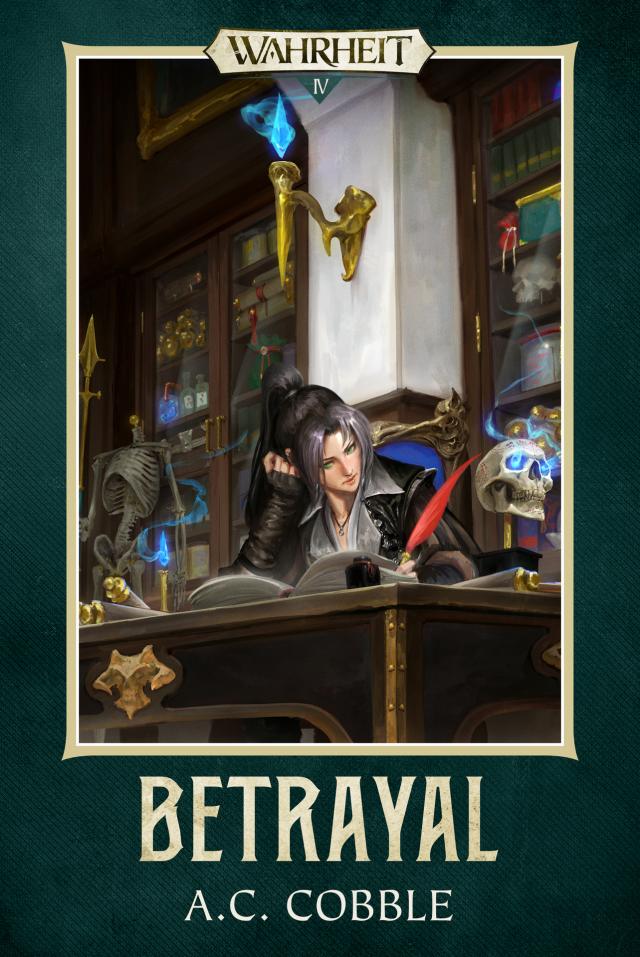


BETRAYAL
Wahrheit Book 4
AC COBBLE
BETRAYAL text copyright
© 2024 AC Cobble
ALL RIGHTS RESERVED
Hardcover ISBN: 978-1-947683-41-9
Paperback ISBN: 978-1-947683-40-2
Cobble Publishing LLC
Sugar Land, TX
Contents
Keep in Touch and Extra Content
The Queen I
The Captain I
The Apprentice I
The Spy I
The Queen II
The Quartermaster I
The Apprentice II
The Captain II
The Emperor I
The Captain III
The Emperor II
The Apprentice III
The Spy II
The Quartermaster II
The Spy III
The Queen III
The Captain IV
The Apprentice IV
The Queen IV
The Spy IV
The Quartermaster III
The Queen V
The Spy V
The Apprentice V
The Captain V
The Queen VI
The Captain VI
The Quartermaster IV
Thanks for Reading!
Keep in Touch and Extra Content
Whether you’re a long time fan or new to my work, you can find my previous books and a better map at: accobble.com.
I also have (really good) series artwork, writing news, the company store, and my newsletter with dozens of free short stories. Unsubscribe at any time, but I send less than an e-mail a month, and it’s the best way to stay updated.
-AC
The Queen I
It was a cold, beautiful afternoon. The sky was a vivid blue, like the feathers of a jay. The sun shone down an iridescent yellow, casting enough warmth to hold the chill at bay for those it bathed with its aura but not enough to warm the shadows. Dense, puffy white clouds drifted placidly to the north, as if to serve as a frame for the rest of the day’s glory. The afternoon felt like a parent’s encouraging hand on the shoulder of a child. A first kiss. A promise that spring was on the way.
A promise, maybe, but brighter days were not there yet, if they were ever going to come. The sun’s rays couldn’t pierce the darkness that stalked these lands. The cemetery, a lonely plot on the backside of a hill two hours’ hike east of Ehrstadt, was covered in grass still yellow from winter and dotted with weathered and splitting boards that had been crudely carved with names and dates.
Christine, the former owner of the Roaring Wench tavern, was buried in a plot marked with the sole marble headstone in sight. If she’d had a surname, no one knew it, so the stone was carved only with her first name and a crude depiction of a tart and a mug of beer. The date of her birth was missing as well, but Queen Ursula Marchand knew the exact moment of the woman’s death, and that number had been chiseled into the stone with care.
The cemetery, far enough from Ehrstadt that the land was worth little, and clinging to a slope that would be impossible to plow, was a resting place for commoners. It was a place for those who had no family mausoleum and no coin to pay the priests in the capital to perform the final rites. It was a place for those who could hire a wagon and a shovel and little else. Like Christine’s, most of the markers were missing surnames and birth days.
There were fistfuls of flowers ringing the span of disturbed earth before the marble headstone. Blooms of brilliant purple with vibrant orange stigma. Ursula had been surprised, at first, thinking some wealthy admirer had purchased the flowers from a hothouse, until Premier Sigismund explained, “Crocus, the first flower of spring. They must have picked them off every hill from the city to here.”
“Were there many people?”
The premier nodded.
She frowned at him.
His eyes stayed fixed upon Christine’s grave.
Not many people had attended, then. Had anyone come? Christine had staff at the Roaring Wench. She had regular customers. Friends, some of them appeared to be, though the tavern owner had shared little about them with the queen.
But it was a two-hour hike to this hill, if one could not afford a carriage. Had the premier himself been the one to collect these flowers? If so, he had not done it for Christine. He’d done it for his queen. He would have wanted to show her that someone, some stranger, cared. But that wasn’t the truth, was it?
She cleared her throat and said, “I wish I could have…”
“It is better this way, Your Majesty. You have time to visit and to mourn, and you were not a distraction to… the others. I know you believed it’d hearten those who were close to her, but the queen at a commoner’s funeral? It would have been a terrible distraction. It would have drawn attention to matters better left ignored. No, this way we keep it about Christine.”
Captain Allgood, the head of Ursula’s palace guard, had explained the day before that he’d been afraid of her safety and what would come of any scrutiny of that terrible night. They’d told a story of what happened, one the minister of intelligence and her other advisors thought plausible, but there’d been rumors. There were always rumors. They couldn’t hide the fact Ursula had been in the Roaring Wench. People had seen several companies of her soldiers on the street before the tavern. They’d witnessed the queen’s carriage arrive. Her movements within Ehrstadt were known, and her presence visiting the tavern would have been the talk of the entire quarter. They couldn’t hide the fact that the proprietor of the tavern was dead, either. The place was popular and had begun attracting the curious even before the tragedy with Count Trabean and Christine.
The attention and curiosity were not unnatural. The people wondered why the queen frequented such a low tavern. They wanted to see what special magic was happening inside to attract a woman who could have gone anywhere. There were already questions on the streets, so if the Roaring Wench had simply closed its doors forever, the rumors would have grown worse.
But because of the frantic lies spread by the ministry of intelligence, the rumors were still wild, inaccurate things. Some were unflattering and some downright cruel, but the librarian had not been concerned. He told her the stories were repeated amongst the common people because they were salacious, not because anyone believed them. She hoped he was correct, but whether or not he was, she’d agreed to play along.
How would it have looked, Allgood had pressed, had she been there at the funeral? Some of the rumors dripped with accusation, and the magistrates always claimed the guilty party couldn’t help but return to the scene of the crime. Her appearance at a commoner’s funeral would have hinted at a truth they were unwilling to tell.
There’d been a risk as well that if anyone close to the woman had seen the queen there, they might have taken it personally and, in their grief, acted irrationally. No one was blaming the queen for Christine’s death, but there was a bubbling suspicion that somehow, someway, she’d been involved. The timing of her visit and Christine’s death was too close for it to be completely unrelated.
Blood filled the footsteps of those who ruled Wahrheit. It had been that way with the kings, and it was no different with a queen.
Ursula did not believe that Christine’s mourners would have looked askance at the queen’s presence. Many would have known the women’s friendship was a true one, but the queen had let the captain of her guards guide her. She was still shaken by the awful events that had occurred within the familiar walls of the Roaring Wench. Accusations, shouts of anger, poison, and then Count Trabean’s blade had pierced Christine’s heart, and it had all ended.
She hadn’t been allowed to see the count, but her advisors had shared the letters he’d written to her. Trabean wallowed in guilt, crying it was not his intent to kill Christine, but there was no denying it’d been his hand that had thrust the sword.
The matter had been put into the hands of the minister of intelligence. Not even Hans Caspar, her minister of law, had wanted to intervene in the spymaster’s investigation. This was no normal case. The stakes were too high, and Caspar was a man of politics as much as he was of the law.
The librarian had turned all his resources toward finding the responsible party, and within a day and a half, he kicked up a nest of easterners. Four men and three women, all from Clermont. When they’d been discovered, four had died on the blade, three by poison—self-administered.
She seethed at the lost opportunity to question the assassins, but they’d poisoned themselves, and there was little anyone could have done to stop it. The librarian acted contrite, aware he’d failed her yet again, but this time she couldn’t bring herself to blame the man. It was obvious the assassins were willing to kill themselves before being held accountable and being forced to reveal their masters. Maybe the librarian could have staged the assault with more care, but there’d been such a rush, such a reckless hurry at her own insistence.
The ministry of intelligence agents had found a wagon behind the small house the assassins had been hiding in, packed for a journey. A day or two, an hour or two, how long would it have taken them to flee? There had not been much time.
The only clue they’d recovered had been a name. Marquis Gustav Klimanq. He was the King of Clermont’s spymaster. Days before, one of the librarian’s agents had reported a meeting between him and Leland Laurent, the landgrave of the province of Brenay. According to the agent’s report, the landgrave had dealt with Clermont but regretted it. Reportedl
Did that matter? High houses did not retain their place in the world by cowering in fear. Did Leland Laurent have blood on his hands again? Was the landgrave involved in this latest plot, perhaps trying to destabilize her throne enough he could take the crown himself? The minister of intelligence claimed the meeting between Gustav Klimanq and Laurent had been staged. It’d been meant as a gift, allegedly. Gustav Klimanq—or at least his head—was meant for her, according to the ministry of intelligence agent who’d observed the occasion, but if the words said in the meeting were a lie, then how could she trust any of it?
Her minister of intelligence was doubtful Clermont had the resources to conduct this operation alone. Her meeting with Trabean in the Roaring Wench had been secret. Hardly anyone outside of the household guard knew of it. Did the King of Clermont have people close to her, or had they been the landgraves’ agents? The librarian offered accusations, but they were all light of proof and suffered from the simple fact that whoever was behind it, there were easier ways to kill her if that had been the goal.
She sighed, wrapping her arms tight around herself. The question remained—who poisoned Christine and the ministry of intelligence agents responsible for her protection? In her heart, she knew it was no simple attempt to kill her. The nature of the plot was too complex. There had to have been another goal. Who would benefit from the death of her friend? Why would they do it? She wasn’t sure. None of them were sure.
Except she did know one creature whose fault in the matter was certain. Six lives for six lives. She hadn’t understood what she’d been agreeing to when she’d spoken to the skiengvaal on the night of her coronation. The foul monster had whispered to her, filling her mind with tortures and agony. She’d known there would be a cost. Deep down, she’d understood that. For the agreement to be made, a price must be paid. She would have done anything for revenge. Sergeant Speckle, a soldier in her father’s service? Yes, she would have offered his life in exchange for that of a landgrave. It was a good deal.
But it hurt. It hurt worse than she could have imagined. Speckle had been a good man. Christine had been a good woman. Ursula was learning, a good bargain or not, nothing was worth the sorrow she felt now. Once she had tasted revenge, she finally understood that the satisfaction of blood was empty. What mattered were the bonds of friendship, and she could never replace the ones she had lost. She would gladly give Manfred Brandt his head back if it bought her another conversation with Sergeant Speckle or another evening laughing over too much wine with Christine.
Christine… What had that woman’s death earned her? Whose blood would she spill in exchange for her friend’s murder? Manfred Brandt was dead. The skiengvaal owed her five others.
“Count Trabean wrote you another note,” Premier Sigismund remarked.
Ursula glanced at him but did not comment.
“You worry he is your enemy?” the premier questioned.
She turned to Christine’s tombstone and told the premier, “I worry that he is not.”
The premier tugged on his generous white mustaches but did not comment. He did not understand what she meant, and she hoped that he never would. The bargain with the skiengvaal had not been worth it, but it was done. Four more of those closest to her were going to die. The premier? Ilse Brinke? There were not many to choose from.
Count Trabean did not know what danger he put himself in by continuing to pursue her. Trabean did not know what danger she put him in by continuing to read his notes and continuing to dream of what could be. She would be the death of him. One way or the other, she would be the death of him.
“Shall we return to the palace, Your Majesty?”
Nodding, she replied, “Yes, Philip, I think that we should. We have much to do.”
“Marquis Gustav Klimanq, Your Majesty,” the librarian murmured.
The tiny little man was in a somber mood. He stood, his hands tucked into his opposite sleeves, his head bowed just slightly, and his wicked smile hidden for the moment, making him look like an aged priest rather than the mastermind behind the Kingdom of Wahrheit’s ministry of intelligence.
It wasn’t just his minions who could play a role. When he wanted to, the librarian could pretend he was out to save lives instead of end them.
But she knew better. She’d seen his work. She’d felt the chaos that he sowed. She would be done with him, if she could be, but for now, she needed him. No matter how much his presence turned her stomach, when surrounded by enemies, it paid to have a knife in your hand.
He’d brought her a sketch on thick parchment that had been drafted by one of his agents who’d managed to infiltrate Landgrave Leland Laurent’s palace and overhear a meeting between the landgrave and the marquis. Evidently, Leland Laurent sought forgiveness. She was not in a place to grant it, and the librarian, despite looking like a priest, wasn’t the sort to push for a reconciliation.
The landgrave was a powerful man, though, and important to the stability of Wahrheit. With Cojita marching toward their border, neither she nor the librarian wanted to weaken the provinces. Marquis Gustav Klimanq, on the other hand, was not important for the stability of Wahrheit.
She leaned over the table, staring at the face of the man on the paper. It was a poor drawing, but she was confident it captured the essence of the marquis. Haughty grandeur, cold disdain, high cheekbones, a sharp chin, thin lips pursed in distaste. The eyes looked like those of the librarian—soulless.
“So this is the man behind Clermont’s attack on my home?”
The minister of intelligence nodded.
“He looks the part,” she mused. She pushed the sketch to the side and saw a crisply written note below. It was not in the librarian’s hand.
“I thought it best you see the words direct from the source, Your Majesty,” the librarian explained. “Sometimes, context is missing in these missives, but the historian has a clear grasp of what information is pertinent.”
“The historian? One of your top agents?”
The librarian grinned. “No, not exactly. He’s not well-suited for this sort of work. If you think of an agent as Gerhard Fischer, this man is not him, but his mind makes intuitive leaps, and because of his caution and care, he finds himself in unusual places, overhearing silent things. The historian has the ability to tackle delicate assignments and unravel the tightest knots, which is why I sent him to Brenay instead of one of my more, ah, aggressive agents.”
“Delicate?”
“Leland Laurent is your enemy and has earned bloody revenge, but we need him.”
“Everyone keeps saying that.”
“I had hoped that Klimanq was sufficient to curb your bloodlust for a time.”
She snorted, then moved her fingers back to the drawing of the marquis. “Tell me of him.”
“A minor lord from an eastern house on the outskirts of Clermont. About as far from Ehrstadt as you can be on the northern continent,” the librarian began. “Several years ago, he showed up in the king’s court but drew little scrutiny from us. There was no reason to believe he was different than any of the other scores of young men from prominent families who sought advancement through proximity to the throne rather than any particular skill of their own. In that regard, Clermont isn’t much different from Wahrheit, or any kingdom, I imagine.”
“I suppose it turned out he was different than the others?”
The small old man joined her, looking down at the haughty face. “Yes. Evidently, Klimanq does have a particular skill. He began collecting rumors about his compatriots, then of the king’s advisors, and then of the powerful economic interests that support Vonpellier like the columns of a cathedral. He began to tie those rumors to events, and he began to use the information to his advantage.”
“How so?”
“At first, it was small, petty revenge. Spurned lovers’ abhorrent secrets were exposed. Rivals in the court found their embarrassments on every tongue. To be honest, there’s a score of men and women attempting the same machinations in your own court. No palace is free from whispers and those who spread them. Klimanq just happened to be better at it than anyone else.”