The golem of deneb seven.., p.1
The Golem of Deneb Seven: and other stories, page 1
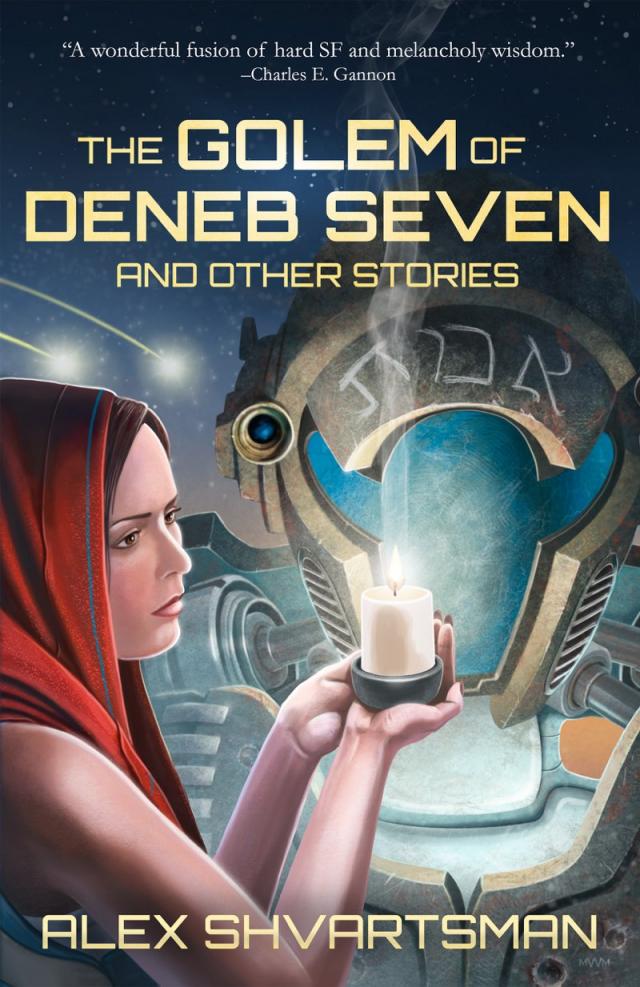


The Golem of Deneb Seven
and other stories
Alex Shvartsman
UFO Publishing
PUBLISHED BY:
* * *
UFO Publishing
1685 E 15th St.
Brooklyn, NY 11229
www.ufopub.com
* * *
Copyright © 2018 by Alex Shvartsman
* * *
All rights reserved. No part of the contents of this book may be reproduced or transmitted in any form or by any means without the written permission of the publisher.
* * *
Cover art: M. Wayne Miller
Interior art: Barry Munden
Typesetting & interior design: Melissa Neely
Cover design: Holly Heisey
Copyeditor: Elektra Hammond
Created with Vellum
Contents
Preface
1. The Golem of Deneb Seven
2. A Perfect Medium for Unrequited Love
3. Burying Treasure
4. Noun of Nouns
5. Whom He May Devour
6. Letting Go
7. The Fiddle Game
8. The Seven Habits of Highly Effective Monsters
9. Islands in the Sargasso
10. Catalogue of Items in the Chess Exhibit at the Humanities Museum, Pre-Enlightenment Wing
11. Fifteen Minutes
12. Masquerade Night
13. The Poet-Kings and the Word Plague
14. Golf to the Death
15. Staff Meeting, As Seen By the Spam Filter
16. Invasive Species
17. One in a Million
18. Grains of Wheat
19. The Ganthu Eggs
20. The Practical Guide to Punching Nazis
21. Dante's Unfinished Business
22. Forty-Seven Dictums of Warfare
23. How Gaia and the Guardian Saved the World
24. He Who Watches
25. Recall Notice
26. Dreidel of Dread: The Very Cthulhu Chanukah
27. Die, Miles Cornbloom
28. A Man in an Angel Costume
29. Future Fragments, Six Seconds Long
30. Parametrization of Complex Weather Patterns for Two Variables
31. The Race for Arcadia
About the Author
Preface
One day I decided to write a novel.
I'd been a lifelong fan of science fiction and fantasy. I'd read thousands of books, seen hundreds of films and dozens of TV shows. I'd traveled the world gaining valuable perspectives and life experiences to imbue my characters with. I'd written hundreds of non-fiction pieces, learning how to express my thoughts on the page. So, how hard could it possibly be to write a book?
I enthusiastically vomited a bunch of words onto the screen, creating a chapter-shaped object. Then I stopped and read it. I stared at the screen horrified, as the vivid, thrilling scene I had imagined turned into a vapid, lifeless bunch of sentences that had no claim on being a story. Worse yet, I had barely an inkling of an idea as to what to do next. I had an interesting story to tell, but I quickly came to realize that I didn't possess the skill to tell it. Worse yet, I realized that writing a book was going to be hard work. And that I hated the idea of writing an entire novel, pouring my heart and soul into it, only to discard the manuscript like a set of training wheels.
I came up with a new plan: I would write short stories for a while. They were less time-consuming, so I wouldn't feel devastated if some of them were false starts. Also, I could submit them to magazines. If a professional editor were willing to publish my stories, I'd know that I had the writing chops to tackle a novel.
Blissful in my ignorance of how any of this stuff worked, I had been lucky enough to stumble onto a viable strategy. Short stories are a great way for a writer to try out different voices, tones, and genres, and to rapidly improve their craft. It took me a few months to sell my first story to a small magazine, and another year to land a professional sale. Many more publications followed. I was ready to write that novel.
Except I didn't.
As it turns out, writing short stories is addictive. I didn't want to stop. There were so many more magazines to break into, so many anthologies with really cool themes that I wanted to be a part of. Since submitting my first short story in 2010, I've had well over 100 pieces published, reprinted, recorded in audio, and translated into a dozen languages. I won an award, and was nominated for another. But I didn't even begin writing my first novel until several years later.
My first collection, Explaining Cthulhu to Grandma and Other Stories, was published in 2015 and included my earlier stories. This second collection features mostly newer stories, an eclectic mix of hard SF, Lovecraftian humor, mythopoetic fantasy, and everything in between. I've written notes to accompany each tale, and the fantastic Barry Munden has drawn interior illustrations, while cover artist M. Wayne Miller and designer Holly Heisey perfectly captured the style and mood of the titular story. I'm proud of this book, and my sincere hope is that each reader will find a few favorites within these pages.
My other hope is that there will be more collections to follow. While much of my creative time is finally spent on novels, as well as various editing and translation projects, I don't think I'll ever be able to give up writing short stories entirely.
Happy reading!
The Golem of Deneb Seven
I was eleven years old when the war came to the Deneb system.
At first, we didn't know that anything was wrong. Mom and Dad were clearing the table after dinner, Avi was building some sort of a castle out of plastic construction blocks, Sarah was asleep in her crib, and Grandpa was reading one of his thick Hebrew books, leaning into the volume and squinting a little by candlelight. I sulked because I was going be the only girl in my class to miss Karen's birthday party tomorrow.
There would be no chatting or video games for me that evening, or until after dinner the following night, because we weren't supposed to use electricity on Shabbos. This weekly routine was difficult to accept while living in a place where few others shared our beliefs. It was far more frustrating this time around, because Dad wouldn't drive on Shabbos, either, and that meant I had no way to get to Karen's party. All the other girls were going to be there. Her parents were bringing in a magician all the way from the city, and it had been the talk of the school for weeks. So I sulked, wondering why God didn't want me to have any fun.
For lack of anything better to do, I was staring out the window when I saw a streak of white light shoot across the night sky. I watched it fall toward the ground in a great wide arc, but before it completed its downward journey there was another, and another.
"Look, Dad, quick! A meteor shower!" I waved him over and pressed my face against the glass. Father set down the salad bowl and came over. He stood behind me and peered out the window. The sky was raining shooting stars.
"Those aren't meteors," said Dad. "They're spaceships. Rivkah, bring me the scroll, please."
I ducked around some of Avi's toys and ran into Dad's study. There was only a little light from the candles in the living room, but I was able to find the scroll right away.
Dad unrolled the flex plastic across the table and swiped it on. Grandpa said nothing, but he watched from across the room and sighed theatrically to express his displeasure. Mom stopped what she was doing, and even Avi looked up from the building blocks, sensing that something unusual was happening.
Dad frowned as he browsed through the news pages on the scroll. "This is bad," he said, without taking his eyes off the screen. "The Oligarchy broke the treaty. They're attacking many of the Union colonies. Not just bombing runs, either. They're landing troops. There are already firefights in the cities."
"It won't be safe here," said Mom, her brow wrinkled with worry lines. "There are too many military families living in our settlement. The oligos will come."
"You're right.” Dad put away the scroll. "We shouldn't be here when they do. Get the kids ready. Pack light, and pack quickly."
"Where are we going to go, David?" asked Grandpa.
"Pearson's cabin," said Dad.
Old man Pearson had built a cabin out in the woods, far away from the settlement. Others liked to tease him about that; about how a man already living on the frontier didn't need another home in the middle of nowhere, but he said that he liked the quiet and the solitude. No one had used the cabin since Pearson died two years back. Few even knew exactly where it was, but Dad had helped him haul supplies there a few times, and he knew the way.
I had a lot of questions, but Mom and Dad had no time for that. They shushed me and went on to collect various things from around the house. Dad flipped the lights on, earning another disapproving look from Grandpa.
"Let's move to a colony world, he said. The family will be safe there, he said," Grandpa muttered, making sure he was loud enough to be heard. Dad clenched his teeth but didn't rise to the bait.
"Stop that, Zvi," Mom called out while folding some of Sarah's onesies. "Who knew the Union would decide to build a military base next door to our new home? At the very least, it took the war a lot longer to catch up with us here than it would have back on Earth."
There had been tension between Dad and Grandpa for as long as I could remember. Back before I was born, when the family still lived on Earth, Dad used to have an older brother named Yakov. Grandpa and Yakov
Yakov and his entire family died in the early days of the war, when the Oligarchy fleet bombed Lisbon. There were no bodies to recover, but a service was held at our synagogue, and Grandpa tried to patch things up with Dad. Dad wouldn't accept the olive branch. He couldn't forgive Grandpa for treating his brother that way.
It was only a month or two later when Grandma died. I was three years old by then, and my parents were planning to leave Earth and find us a safer home. Grandpa asked if he could come along because we were all the family he had left in the world, and Dad relented. Grandpa has lived with us ever since, but the two of them never managed to grow close again.
After an hour of preparations, the adults loaded the bags into the truck.
"I should stay," declared Grandpa. "Keep an eye on the house, in case there's looting."
"Looting?" Mom threw her hands up. "What do we have that anyone should want to loot?"
"He just doesn't want to get into the truck on Shabbos," said Dad. "It's okay to drive when lives may depend on it," he told Grandpa. "The Talmud spells that out for stubborn old men like you."
"I've lived too long when my own son is quoting holy texts to me," declared Grandpa, but he climbed into the truck.
We rode in silence for what felt like a long time. I watched the trees on the side of the dirt road, which looked kind of like badly drawn caricatures of Earth trees. The brown of their bark and the green of their leaves were a shade off from what I remembered. Similar, but different, kind of like our lives on Deneb Seven, or Sev as everyone here called it.
Finally, Dad drove the truck off the road and hid it in the bushes. We walked the rest of the way, dragging heavy bags through the forest. It was a cloudless night, Sev's moons providing enough light to travel by.
The cabin was dusty and small, but it was dry. The wooden walls and roof had withstood the test of time.
After the adults unpacked, we sat on the bench in the front of the cabin and watched dozens more falling stars make landfall. They seemed pretty and non-threatening to me. But then I looked at Mom, stone-faced and holding Sarah in her arms, and Dad, chewing his lip, and I was afraid.
By the time we woke up on Saturday morning, the Oligarchy forces had taken over two of the three cities on Sev and there were skirmishes in many of the settlements. My parents wouldn't let me watch any of the video; they said I was too young to see people die.
In the afternoon, there were reports of heavy fighting at the military base near our settlement. Also, that the Union was launching a counterattack across the entire sector.
By evening, the information feed went dead. We kept checking, but the planet-wide information network was down. We were truly cut off from the world.
I spent the weekend playing with Avi, exploring the woods around the cabin, climbing trees and gathering local fruit that looked like miniature pears and tasted a little like cucumber. Mom worried, but Dad had assured her that there were no dangerous animals or poisonous plants for us to fear. Sev was a tame, gentle world. It was why the family chose to move here in the first place.
Several times I heard faint rumbling sounds. I didn't know if it was gunfire or distant thunder. The war was too far away, too surreal. I kept expecting Dad to declare the whole thing over, and for us to go home and resume our lives, the entire outing nothing more than an extended, strange holiday.
On Monday, the refugees came.
There were a dozen of them, mostly young men and women, their clothing disheveled and dirty. Several of them wore bloody bandages. One man had a splint on his leg, and two others were helping him along. Some of them had guns.
"Who the hell are you?" A man in his thirties stepped forward from the group. There were scratches on the side of his face and neck, as though he'd been attacked by a crazed cat.
My father and he studied each other warily. "We're the Sheynson family. From the settlement," said Dad.
"This is my uncle's cabin," said the man. "You're trespassing."
"Mike Pearson was my friend," said Dad.
"Well, I don't know you, so you better clear out, fast." The man rested his hand on his holstered handgun to underscore the point.
Dad took half a step back and raised his palms. "Let's be reasonable about this," he said. "I have three young children. Are you really willing to kick them out? We can work together. My wife can help properly clean and dress those cuts."
The man thought about it for a few seconds, then his frown deepened. "These aren't reasonable times," he said. "There's hardly enough room here for my own people, and we can't afford to be charitable. You and your family need to go."
The refugees watched, their expressions grim, as my parents scrambled to get our stuff out of the cabin.
While Mom, Grandpa, and I packed, Dad pulled a stool up to the wall, and used it to reach for the hunting rifle Pearson had mounted there.
"What do you think you are doing?" asked Grandpa. "Those men look like they know how to use their guns, while you barely know which end of this thing to shoot from. You'll get yourself killed."
Dad tugged at the weapon. "I don't intend to fight them," he said. "I want the gun for protection. Who knows what we'll have to face on the road."
"And is that how they'll interpret you walking out of this cabin with a weapon?" asked Grandpa. "Besides, there aren't any bullets. We're better off without it."
Dad didn't like it, but he climbed off the stool and helped us pack.
"Leave the food," said Pearson's nephew when we dragged our packs outside. "We ran out hours ago." He shifted uncomfortably from foot to foot. "Take only a little bit with you," he added. "For the kids."
"Hold on now," Dad said, stepping forward. "It's one thing to kick us out. I'll be damned if I'm going to let you steal our food."
Three different men cocked their guns. They didn't say a word. Their wild, hungry eyes said it all.
"What's happening out there?" asked Grandpa. I couldn't tell if he was trying to distract the group of men or if he was really just that clueless.
"It's bad," called out one of the women. "You better keep off the main roads. They don't have any qualms about shooting civilians."
"The Unies are on their way," said another woman. "We just have to hold out for a few days."
The rest of the refugees looked at us sympathetically as we marched away, but no one spoke up to suggest we stay.
The truck was where we left it, but its battery was gone. Someone had pried the hood open and stolen it to power their own journey.
Dad punched the side of the truck with his fist. "When it rains…" He paused. "Fine. We'll just have to walk."
"Where are we going?" I asked.
"Home," said Dad.
"I thought home wasn't safe?"
Dad sighed. "We don't know of any safer place we can get to, sweetheart. We'll just have to keep our heads down and hope that the fighting has moved on to somewhere else."
I thought about that. "We could make a camp!"
"We have no gear or supplies," Dad said. "And the forest is no place for a baby—or a four-year-old, for that matter."
"The settlement is at least five hours away by foot," said Mom.
"There's nothing to be done about that," said Dad. "We'll take lots of breaks. There's what, six, seven hours of daylight left?"
"Just about," said Grandpa. "And it's not like we're in any special hurry to get there."
We took the water and what little food we had been allowed to keep from the cabin, left everything else in the truck, and walked down the road.