The salvage, p.1
The Salvage, page 1
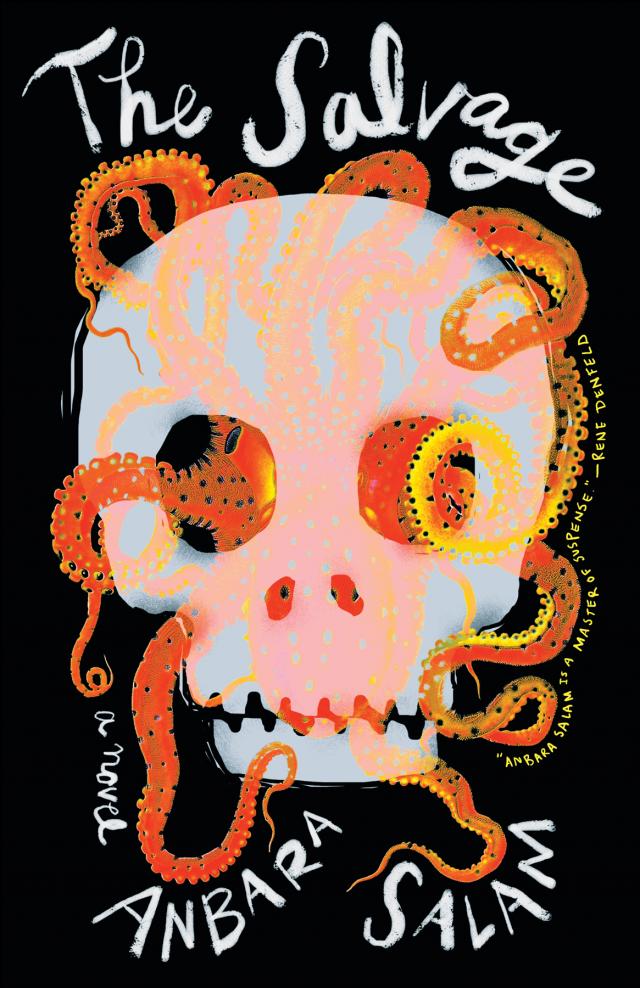


THE SALVAGE
a novel
ANBARA SALAM
For Struan
THE SALVAGE
AUTHOR’S NOTE:
On Christmas Eve 1962, an intense cold front plunged Scotland, England, and Wales into the “Big Freeze”: the coldest winter on record since 1740. Blizzards and Arctic conditions gripped Great Britain over the following months, and the next frost-free day didn’t arrive until March 6, 1963.
1
SATURDAY, OCTOBER 20, 1962
When I arrive at Port Mary Harbour, there are already men in the fishing boats. Their oilskin aprons creak as they winch in ropes and haul rusted cages, seawater rolling down their arms. Nudging one another, they fall silent as I walk along the pier. I raise my head, keeping my eyes on Colin’s boat. He’s sitting on the stern, drinking from the cup of a plastic thermos, the radio tuned to a drama. As I approach, he leans into the wheelhouse and clicks the dial to the BBC World Service for the news.
“Is that you ready, then?” he says, looking me over.
I’m wearing a dirty fleece and holding a margarine tub containing two jam sandwiches, likely not what he imagined of a professional diver. “Yes, I’m all ready.”
“Thought there’d be more”—he gestures—“bits.”
“All my bits are already here.” I point to the wheelhouse, where my equipment was locked overnight. My tone is sharp, and I try to offset it with a smile.
“Aye, fair enough.” He tips his head. “Come on, then.”
Colin starts the motor, and as we pull through the harbour, the fishermen stop working to watch us—lines go slack, ropes slop into the water. I check that the batteries are in the camera, the pressure gauge is set, the seals around the mouthpiece are intact, my torch is working. When I turn to look over my shoulder, the eyes of the men are still on us. A young man in a green pullover lifts his cigarette butt overhead, like a javelin, and tosses it in our direction. Behind us, Port Mary’s coastal street stretches into view—a row of pastel pebbledash houses, two splintered benches, the boarded-up windows of the old pleasure pavilion. The roof of the Grand Hotel looks shabbier from this distance; the whole island seems improbably exposed, a scribble on slate. Colin’s boat knocks through the waves, and as Cairnroch Island grows smaller, my heart starts jittering. It’s my first dive down to survey the shipwreck, and I have to get it right. This is my chance to do something right.
After nearly an hour Colin must feel me looking at him, and he slows the engine, checks the map, the compass. “Here.”
I’m looking down at my own map and compass. He’s farther away than I’d like, but I nod. Colin looks deliberately away while I shrug off my fleece. I check the camera again, the pressure gauge, the fit of my regulator, the torch. Heaving on my air tank, I’m gripped by sudden paranoia. Alex mixed my tank up for me before I left Edinburgh. I check the taste now through my regulator—he wouldn’t—no, it just tastes normal, like rubber. Surely even Alex doesn’t hate me that much. Sitting on the gunwale, I squeeze into the flippers, attach my belt. Oily water from the motor splatters over my knees as Colin lobs the anchor overboard.
“Do you feel confident with the signals we discussed yesterday?” I ask.
“Aye,” he says.
I wait a moment, but he doesn’t offer more detail. Realistically, Colin’s not going to be able to do anything if I have a problem while I’m down there, anyway. It’s forty miles and an unreliable ferry between me and anyone qualified to help me if my equipment fails. Diving alone is against every code of honour in the trade, but clearly my safety isn’t Alex’s priority right now.
“I’ll see you in about half an hour,” I say, giving Colin a thumbs-up, which, even while I’m doing it, makes me feel foolish. He nods at me. I strap on my mask, click my neck, breathe out, and push myself back, over, and down, into the water.
IT’S EVEN COLDER than I’d expected, a blow that knits my muscles together. Pushing all my strength into kick kick kick I swim down down, concentrating only on moving. My heart is racing from the slap of cold. As I reach ten feet, I paddle in place, circling my arms, waiting for my heart and breathing to settle. I unfold the waterproof map, check the compass again. I was right, Colin was off—stupid of me to waste time and air. The pain of the cold pulls back, replaced by a fizzing in my limbs. My breath is loud and regular in the mask, and I have a strange urge to do a somersault. I’d forgotten how much I missed this. Kelp towers above me, collared with fluffy crimson algae. I weave through the boughs, the wet lick of the fronds against my legs, slim fish flashing tin in the bubbles. Kicking through a patch of seaweed disturbs a cloud of trembling jellyfish the size of buttons, and they shimmer alongside me as I swim northeast, following the dip of the seafloor.
The seabed drops abruptly to a plateau. I’m down on the shelf now; it’s darker here, sheltered by the kelp forests to either side. I descend four more feet, into the shadowy water near the seabed. A flickering, gloaming light filters through the kelp, and orange tentacles of seaweed furl and unfurl around my legs. I switch on my torch. And there she is.
HMS Deliverance.
None of the scoping material did her justice. The Arctic waters where the ship was found have preserved it like it was stoppered in a bottle. The greenheart wood planks are intact; the name plaque on the stern is barely tarnished. My skin is tingling. I knot the end of the guideline to the clip of the inflatable buoy, then put my mouthpiece to the balloon, tie it, and let it float to the surface. Hopefully, Colin is watching and will bring the boat around. I try not to imagine what will happen if I surface and he has just sailed away.
The camera is weightless in my hands, and I steady it to take the first photograph. The flash lights up the name plaque, the fresh lichen the ship has collected since being towed to Scottish waters. Swimming towards the aft deck, I take more photos—the dents in what I can see of the retractable rudder, the ice scarring on the greenheart, the clamps along the gunwale from the towing gear. The main hatch is already open, a small mercy for my purposes, and my torchlight shines back on a wooden ladder, paint worn in the centre of each rung where the crew’s footsteps buffed it away. I pull myself down through the hatch and into the ship.
The first dive into a ship is an otherworldly experience. It’s travelling into a moment that has been paused in time. When Jenine and I were young, we used to play a game where we peeked through other people’s windows and made up stories about their lives. It was a winter game, best played after the brooding Glasgow sunset, when strangers’ front rooms would be lit up by the fire, teakettles whistling from back kitchens. The boards of HMS Deliverance are lacy with algae, and I trace my fingers over knots in the wood. It gives me the same kind of thrill I felt back then, as the unseen observer of someone else’s world. Like I have become both invisible and all-powerful. Being the first diver to visit the ship after her relocation means that I’m exploring a place almost nobody has been in over a hundred years, since she sank. I have her all to myself.
Inside the passage, the lips of water beyond my torchlight are coal black, stippled with freckles of sediment. Slowly, I ease myself along the narrow corridor that leads to the crew quarters. The cabins along the right-hand side are frozen in Victorian grandeur. They look exactly as they must have in 1849, when the boat last left Port Mary Harbour: wooden panelling, narrow bunks built into the walls. I expected there would be breakage from when the ship was towed back here, but she was made for movement: furniture nailed to the walls, drafting pens fixed to writing desks. I take photographs of the crew quarters, the flash glinting on shaving mirrors shrouded in webs of algae. I’ve never seen a site like this before—it seems almost staged in its completeness, like a doll’s house. Through the silt I spot an ivory-handled clothes brush and a tin spectacle case tucked into the rail of the first officer’s bunk. Lord and Lady Purdie will have their pick of trophies for their museum. After taking pictures in the next three rooms, I kick gently down to the far end of the starboard side. A silver-coloured pollock has slipped in from the kelp on the seabed and darts in startled zigzags as I approach the reason for my trip to Cairnroch Island: Captain Purdie’s bunk.
The door is sticking to the floorboards, and I deliberate for a moment before sliding my knife through the algae and dragging open the door, a fog of silt seeping into the water. I float against the ceiling of the passage until it’s settled enough for me to see my own hands again, and pull myself through into the room. The skeletal remains of Captain James Purdie appear in the frame of torchlight. Curled on the bottom bunk, his knees are drawn to his chest, wisps of hair drifting softly around his skull. His skeleton is well preserved, his bones dappled with gooey-looking sediment. Nestled under the remains of Purdie’s hands is a chunky golden ring—unusual for a Calvinist of this era, but perhaps it was a guild gift. I have to focus at close range to take a photograph, illuminating the faint outline of a barque engraved on the bezel. The Purdies will lose their minds over the ring—there couldn’t be a more perfect museum showpiece. Through the speckles of silt I peer through the doors of a glass-fronted cabinet, which contains a pair of bone snow goggles, a horn comb, and a toothbrush, the bristles still intact. There is no porthole, but dents in the wall mark where nails must once have held up maps or schedules, maybe photographs from home, and slotted into a niche in the wall is a small gilt mirror. On the table next to Captain Purdie’s bunk is what looks like a copper coin, a fringe of glutinous seaweed smothering it to the surface of the wood. The discovery report recorded that the top drawer of the desk contains th e provisioner’s ledger and the captain’s expedition journal, but the Danish team who found the ship were pessimistic about the likelihood of the books surviving the tow. The drawer has become gummed with seaweed, and I carefully drag my penknife through the fronds, praying I haven’t accidentally cut the material. When I prise open the drawer, the two leatherbound books inside seem to have held up much better than anticipated. Gingerly, I open the books and take photos at random to send back to Sophie, the textual expert at the museum in Edinburgh, for review. The captain’s diary contains pre-lined boxes for recording the latitude and longitude, as well as wind speeds and temperature. But I can’t make out the writing—visibility is too poor, and deciphering handwriting isn’t my strong suit in any case.
Swimming away from Captain Purdie’s remains, I squeeze through the passageway into the galley kitchen, where two metal spoons still hang from pegs on the wall. There is a horn cup engraved with Captain Purdie’s initials attached by a snap hook above the grate. It must have been his personal drinking vessel. I haven’t seen this type of fixture before; it’s a clever little grooved latch to stop items from falling during bad weather, and I take a couple of extra photographs. The pantry is stacked with corroding tins and stoneware jugs nailed into position with wooden dowels. It’s odd the crew would have left this many tins here before abandoning the ship, but I suppose they must have taken the dried pemmican with them. Maybe one day their remains will also be discovered. I wonder if Lord and Lady Purdie will pay for their repatriation, too, or if their generosity only stretches to their ancestors.
My regulator glitches; it hiccups with a start, and I brace myself in the corner of the room. Don’t panic, I say to myself, release the valve, and it cocks back again. For a moment, I give myself permission to miss Alex, knowing that we could always rely on each other during a dive, if not above water. On the other side of the kitchen is the saloon, the only space on the ship large enough for group meals or socialising. The walls of the saloon curve inwards, and it feels smaller than I’d expected, silt gently coasting in the water like snowfall. It must have been claustrophobic for the crewmates to spend the dark Arctic winter cooped up in here while they planned their escape across the ice. The table riveted to the floor has gouges cut into it, someone marking down time, measuring wins or losses. As I take a picture of the grooves, a cupboard door on the far side under the porthole smacks open. I jump, and the circle of torchlight swings to the ceiling. The bubble of my laughter echoes in my mouthpiece. I right the torch. The storage cupboard is only knee-high and set at an angle with a latch to prevent it from knocking open on rolling seas. In my surprise, I’ve unsettled the sediment, and it is rippling in creamy ribbons that fill the room, like ash. It’s hard to take photos in such poor conditions, so I lever myself against the table to swim back the other way. As I begin to pull myself from the saloon, a flicker of movement behind me catches my eye. The cupboard door is closing again. Slowly, this time. I must have created an eddy of pressure. Or it’s a fish, knocking against the wood. I blink back into the room through the ripples of silt, raising my camera.
And there, underneath the window, a man is crouching.
2
SUNDAY, OCTOBER 14, TO MONDAY, OCTOBER 15, 1962
To catch the ferry to Cairnroch island, I’d driven from Edinburgh up to Inverness and spent the night in a cheap bed-and-breakfast near the rail lines, headlamps from freight trains chattering in the gap between the curtains. I was the first customer in the co-op in the morning when I went in to pick up supplies for the island, eliciting an arched eyebrow from the girl at the till, who must have supposed I was preparing for an eccentric breakfast of batteries and sanitary napkins. As I set off along the coast, a belt of fog rolled over the road and I drove slowly, hearing rather than seeing the waves against the rocks. Every so often, a box of late-season apples left by the side of the road appeared out of the mist, and I stopped near Greenacre and stood over the hot hood of the car, the apples limp and leathery between my teeth.
Signs for the Cairnroch ferry appeared after Galen, and the turning revealed a black-and-gold teahouse shaped like a pagoda, sitting improbably in a loading station clogged with oil drums and lobster crates, slick, gritty puddles of cigarette stubs and sluiced water from dripping mackerel. Mr. Tibalt, the manager of the Cairnroch Grand Hotel, had told me over the phone that it was hard to come by gas on the island, so I’d decided against bringing my Ford Prefect for the sake of only a few weeks. There were no other patrons in the tea shop, and through the window I watched people calling to one another from amidst the jumble of fishing wire and felt self-aware that I was the sole ferry passenger sheltering indoors. My skirt, which had seemed positively modest in Edinburgh, now felt far too short. An old woman wearing a maid’s mob cap delivered the tea in a teacup made of such thin china I could have read the Bible through it.
Half an hour before the ferry was due to leave, I asked for the bill, and when the woman came back she lingered, hovering over me so that I felt compelled to add an extra shilling to my plate.
“You’re it, are you?”
I looked up, bemused.
“The diver.”
“Yes, that’s me. I’m me.”
“Thought they’d send someone at the top for something as important as this?”
I gave her an insincere smile. “Well, I volunteered for this assignment. Don’t worry, my boss is still in charge.”
She nodded but didn’t move. I wasn’t sure what she wanted from me, so I said, “Are you from Cairnroch yourself?”
“Oh, no. We used to go on holidays as a child, but not since …” She gestured at the faded pictures of Rathdunon Castle framed on the walls. The castle was destroyed by a German strike during the war, now apparently not much more than a pile of rubble. Cairnroch never recovered its place as an affordable summer holiday spot. Even now, the paintings of the Purdies’ ancestral home have the same nostalgic dolour of a cardboard memorial photo of an airman gunned down by the Luftwaffe. Lewis had a well-thumbed souvenir postcard of the castle on the cage of his electric meter in his flat. A relic from the last trip home before his dad died, the last summer he was happy, he said. Never passed up an opportunity for a bit of melodrama.
“And is it true that he’s down there?” She leaned forward.
I licked my lips. “Captain Purdie?”
She tutted, as if I’d said something stupid. “Yes, Auld James. He’s really come home?”
As a corpse, I thought. Out loud I said, “In a sense.”
She looked around the tea shop. “Imagine. Sailing back home again in his own ship. And now he’s getting to his rightful resting place.” She reached out and gripped my hand. “God bless the Purdies. Everything round here will be changed. Like the good old days.”
It occurred to me she might have been working in the tea shop since before the war. Twenty years of boiling the same kettle, wiping away other people’s lipstick smudges. The thought depressed me. “You might get a better uniform,” I said, aiming for a joke.
Her expression tightened then. “Better get going. They’re punctual around here.”
I looked out the window. If they were punctual, it would be the first island I’d ever visited in my life that didn’t have a magnanimously long-era sense of time. A man wearing a waxed cap appeared at the door and gave me a hard stare before leaving again.
I hurried after him. “Are you looking for me?”
He chuckled. “No, hen. Get one of the men on the dock to help you with your bags.”
I cleared my throat. “I don’t need help with my bags. I’m the diver. Mr. Tibalt mentioned I should check in with someone.”
He jerked his head back. “Oh. That’s you, is it? I heard the Purdies were sending someone. I thought …”
I could guess what he thought—that he was looking for a man. “No, yes, no,” I said.
Running his tongue over his teeth, he said, “I wouldn’t have expected a nice girl like you to be in this line of work.”
“Well, that’s me.” Then I added, “Sorry.” Although I wasn’t sure what I was apologising for. Not being a nice girl, perhaps. A squirm of self-hatred passed through me.