

Victor appleton tom sw.., p.1
Victor Appleton - Tom Swift Jr 23, page 1
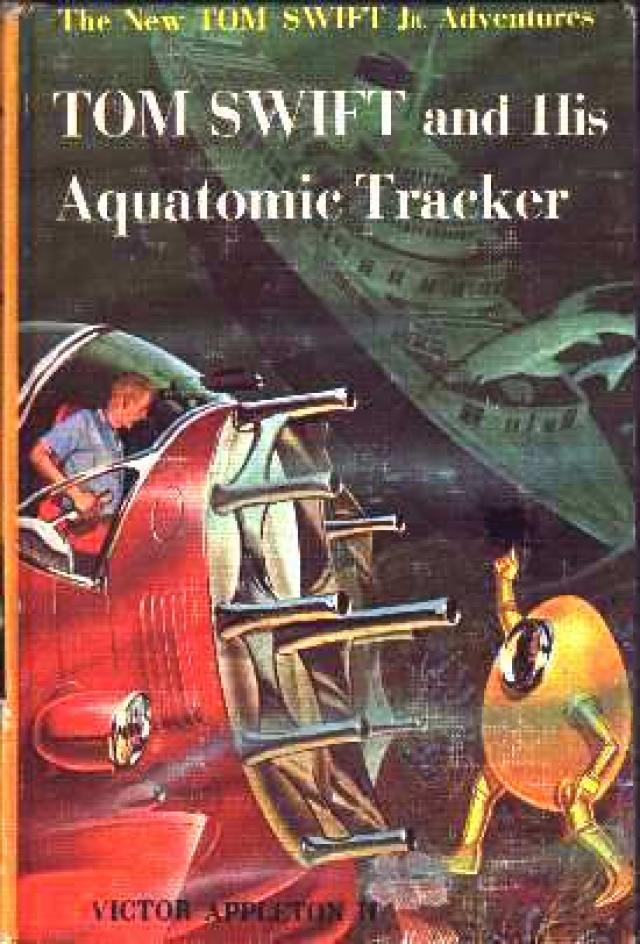


TOM SWIFT AND HIS
BY VICTOR APPLETON II
No. 23 in the Tom Swift Jr. series.
The Tom Swift Jr. series:
1 Tom Swift and his Flying Lab (1954)
2 Tom Swift and his Jetmarine (1954)
3 Tom Swift and his Rocket Ship (1954)
4 Tom Swift and his Giant Robot (1954)
5 Tom Swift and his Atomic Earth Blaster (1954)
6 Tom Swift and his Outpost in Space (1955)
7 Tom Swift and his Diving Seacopter (1956)
8 Tom Swift in the Caves of Nuclear Fire (1956)
9 Tom Swift on the Phantom Satellite (1956)
10 Tom Swift and his Ultrasonic Cycloplane (1957)
11 Tom Swift and his Deep-Sea Hydrodome (1958)
12 Tom Swift in the Race to the Moon (1958)
13 Tom Swift and his Space Solartron (1958)
14 Tom Swift and his Electronic Retroscope (1959)
15 Tom Swift and his Spectromarine Selector (1960)
16 Tom Swift and the Cosmic Astronauts (1960)
17 Tom Swift and the Visitor from Planet X (1961)
18 Tom Swift and the Electronic Hydrolung (1961)
19 Tom Swift and his Triphibian Atomicar (1962)
20 Tom Swift and his Megascope Space Prober (1962)
21 Tom Swift and the Asteroid Pirates (1963)
22 Tom Swift and his Repelatron Skyway (1963)
23 Tom Swift and his (1964)
24 Tom Swift and his 3D Telejector (1964)
25 Tom Swift and his Polar-Ray Dynasphere (1965)
26 Tom Swift and his Sonic Boom Trap (1965)
27 Tom Swift and his Subocean Geotron (1966)
28 Tom Swift and the Mystery Comet (1966)
29 Tom Swift and the Captive Planetoid (1967)
30 Tom Swift and his G-Force Inverter (1968)
31 Tom Swift and his Dyna-4 Capsule (1969)
32 Tom Swift and his Cosmotron Express (1970)
33 Tom Swift and the Galaxy Ghosts (1971)
From the front page:
Tom Swift and his pal Bud Barclay embark on one of the greatest scientific adventures of the century-a daring underwater crossing of the Atlantic Ocean, equipped only with Tom’s electronic hydrolung suitsl Hundreds of miles from land, the hydrolung batteries inexplicably go dead and the two boys are dramatically rescued in the dark of night. Examination of their equipment reveals sabotage.
A complex clue leads Tom to believe there is a connection between the sabotaging of the hydrolung and the sinking of the S.S. Centurion -which went down in mid-Atlantic with a fortune in gold bullion and a world-famous statue aboard. After making good on their second attempt to accomplish the nonstop swim under the Atlantic, Tom and Bud are given the assignment o£ salvaging the Centurion’s valuable cargo. To locate the sunken ship, Tom designs the , an astounding device which detects and identifies metallic and chemical traces left by an object in water, then tracks the object.
How the young scientist-inventor outwits the vicious saboteurs and traps the most fiendishly clever mastermind of crime he has ever met makes a fast-moving story of super-suspense.
ILLUSTRATED BY EDWARD MORITZ
GROSSET & DUNLAP
© 1964 BY GROSSET It DUNLAP, ING. ALL RIGHTS RESERVED
PRINTED IN THE UNITED STATES OF AMERICA
CONTENTS
1 The Drowning Roman
2 SOS!
3 Chow Winkler, Detective
4 The Singing Merman
5 Deadly Trawler
6 Tom Swift’s Double
7 A Transatlantic Call
8 London Dragnet
9 The Undersea Mesa
10 Bloodhound Experiment
11 The Shark Man
12 Mystery Millionaire
13 Gold Clue
14 The Secret Crypt
15 Prisoners
16 A Gruesome Foe
17 Vanished Evidence
18 Sonar Signal
19 Danger Trail
20 Trapped Below
CHAPTER I
THE DROWNING ROMAN
“Tom, this will be one of the greatest scientific adventures of the century!” declared Dan Perkins of the Shopton Evening Bulletin. “We’ll all be pulling for youl”
“Thanks, Dan.” Tom Swift Jr., the famous young inventor, and his friend Bud Barclay, grinned gamely as a crowd of reporters bombarded them with questions and comments.
“I venture to say it will rank with the first transatlantic flight and your first space orbit!” The TV interviewer extended a microphone toward Tom.
“We will succeed,” Tom said soberly.
The newsmen had gathered at the Swift rocket base on Fearing Island to watch the two boys take off on a daring underwater crossing of the Atlantic Ocean, equipped only with Tom’s amazing electronic hydrolung suits!
“Our faces will sure be red if we don’t make it after all this build-up,” muttered Bud.
Tom agreed. The tall, eighteen-year-old scientist had planned the test as a private experiment in undersea survival and mobility. But due to the excitement and enthusiasm of Swift Enterprises’ personnel, it had proved impossible to enforce the news-blackout order.
“How long will the crossing take?” a Consolidated Press reporter asked Tom.
“We estimate five or six days, based on the speed of our ion-drive jets.”
“Isn’t it dangerous for you two fellows to be going it alone with no rescue ship to accompany you?” a writer for Worldweek magazine queried.
Tom shrugged. “We’re hoping to prove that man can truly adapt to inner space-that is, die undersea environment. The test wouldn’t mean as much if we carried it out while tied to a ship’s apron strings, so to speak.”
“Are you sure this whole thing isn’t more of a publicity stunt than a scientific experiment?” another reporter spoke up.
Bud sizzled at this remark, but Tom answered politely. “Please remember that we are not asking for publicity. This press conference was arranged only at the request of the news media.”
Other newsmen backed up Tom’s statement. Several apologized for their colleague’s heckling query.
“I just want to know if the trip will have any practical scientific value,” the reporter persisted, a bit red-faced.
“Scientists don’t always limit their research to practical matters.” Tom grinned. “However, this test will prove whether our gear can be used for survival at sea after shipwrecks and air crashes. We’re also blazing a trail for later field study of the undersea enviro nment at firsthand by oceanogra phers and marine biologists. And we hope it may open new possibilities in offshore mining and oil prospecting.”
“Some experts even claim that man will have to seek new living space under the sea someday,” put in Bud. “Isn’t that right, Tom?”
“Right-but that day is a long way off, I hope,” the young inventor added with a chuckle.
Presently Tom excused himself and Bud so that they could don their hydrolung suits. Harlan Ames, Enterprises’ lean, dark-haired security chief, accompanied the boys out of the base’s main building and climbed into a jeep with them.
“Neat job you did, skipper, fielding all those questions,” Ames remarked as they sped to Tom’s island laboratory.
“I still wish we could have skipped all the publicity,” the young inventor said.
“So do I.” Ames added dryly, “You’re hard enough to guard without broadcasting any plans.”
Fearing Island-a bleak, sandy dot off the Atlantic coast-had been converted by the Swifts into America’s first spaceport. Its launching area bristled with skyscraper-tall rockets, including Tom’s pioneering Star Spear. The island also served as a submarine base for his diving seacopters and jet-marines.
Arriving at his laboratory, Tom strode to a shelf laden with chemicals and electronic equipment, uncorked a bottle of pills, and shook out three apiece for himself and Bud.
“Our final dose of space vitamins.”
‘Tour dad and Doc Simpson really gave skin diving a big scientific assist when they concocted these from those outer space plants,” Bud said gratefully.
“We hope so-but the real test of their effectiveness will be our days of underwater life,” Tom replied. “On shorter dunkings, they’ve done a great job of protecting our body tissues from antiosmosis troubles.”
“Down the hatch!” Bud gulped a swallow of water. “Okay-let’s get into our rigs!”
As the two hydronauts started into the one-room apartment adjoining the laboratory, a red light flashed on the control panel of the Swifts’ private TV network. Ames flicked on the videophone.
“Hold it, Tom!” he exclaimed as Blake, their Washington telecaster, appeared on the screen.
Tom and Bud hurried back into the laboratory.
“This may be important, skipper,” Blake said. “John Thurston has something to show you.”
Thurston, a calm-faced, balding official of the United States Central Intelligence Agency, stepped into view before the camera. “Hi, Tom. All set to leave on your transoceanic marathon?”
“Bud and I were just about to get into our hydrolung outfits.” Tom smiled. “What’s up?”
“Take a look at this.” Thurston held up a photographic print, and Blake switched to a close-up so that it filled the video screen. The print showed a crude drawing of a Roman soldier sinking head downward into water. Below was a row of hieroglyphic symbols.
“What the dickens is it?” Bud asked.
“A radiophoto containing some sort of code message,” Thurston explained. “The FCC monitored this on an unidentified broadcast last night and turned it over to us.”
Tom frowned. “Have you doped it out yet?”
“We’re not sure. Our cryptographers have been working all night to crack the code. The message is too short to yield a positive solution, but they think it meansStop Tom Swift.”
“Great Scott!” Ames exploded. “Have you any idea who or what’s behind the message?”
“Not a clue,” Thurston replied. “We were hoping you fellows at Enterprises might know.”
“I take it the message was a translation of the code symbols only,” Tom put in. “How about the drawing of the drowning Roman soldier?”
“It has us baffled,” the CIA man admitted.
Tom rubbed his blond crew cut thoughtfully. After a moment he said, “Well, no sense worrying about it. Thanks for telling us, John. Let’s go, Bud!”
“Hold on, Tom!” Ames protested. “You’re not going through with your trip after this warning?”
“Why not?” the lanky young inventor retorted.
“Too risky, skipper! Some enemy may be planning to attack you and Bud en route!”
Tom shrugged. “The message may not have been meant for us-besides, we can’t back out now. This experiment is important.” He turned to Bud. “What do you say?”
“Ditto.” The muscular, dark-haired young Californian, who was also Tom’s air and space copilot, grinned cockily. “Come on!”
Ames flung up his arms in despair.
“That’s what I expected.” Thurston smiled. “At least watch your step, Tom. Good luck!”
“Thanks, John. And we’ll keep our eyes open for any old Romans down in Davy Jones’s locker!”
As soon as the Washington telecaster had signed off, the boys hurriedly changed into their hydrolung suits of rubberlike black plastic. Molded into each suit was an electronic device which extracted oxygen from the water for breathing, and a density-control unit for rising or sinking to any depth at will. At the back was a slender metal cylinder-the ion-drive jet, capable of propelling the submerged wearer at high speeds.
On his left wrist, each boy wore one of Tom’s miniaturized “porpoise” sonarscopes and a fingertip control to all units. Power was supplied by a Swift solar-charged battery. On the other wrist, the hydronauts wor e depth-gauge calendar watches. Pouches on their thighs contained sealed recording instruments, and Tom also carried detonators for sound-channel testing by SOFAR-Sound Fixing and Ranging.
The boys left their hoods-with built-in transparent face masks and sonarphones-unzipped and hanging down over their chests so they could talk freely before submerging. As they left the lab, Bud exclaimed, “Hey! Look who’s here !”
A blond girl with laughing blue eyes called from a parked car, “You didn’t think we’d let you go without a final sendoff ?”
She was Tom’s teen-age sister, Sandy. Their distinguished scientist father, Tom Sr., was at the wheel with Mrs. Swift beside him. In the back seat were “Uncle Ned” Newton, manager of the Swift Construction Company, with his wife and daughter, Phyllis-Tom’s favorite date.
The two boys managed to squeeze in, and Ames followed their car in the jeep.
When they arrived at the south dock, where many of the Swifts’ submarine craft were berthed, a roar of excitement rose from the newsmen and base personnel. Television cameras were maneuvered into position and microphones were thrust close to Tom’s and Bud’s faces.
“What about your provisions for the trip?” a newsman inquired.
“Our suits are of double-walled cellular plastic and contain food in liquid form,” Tom explained. “We’ll draw through feeding tubes.”
“How about that boxlike gadget attached to your belt, Tom?” a reporter asked.
“It’s a portable, miniaturized automatic navigator for frogmen that I’ve developed. We’ll be trying it out for the first time.”
“And those handguns?” A TV man signaled his camera to zoom in. “Are they to repel sharks?”
Tom laughed. “No, they’re a new invention of mine-an ‘undersea light switch.’ They emit a chemical that excites luminescent sea organisms and makes them light up the water. Of course, we have battery lamps, too, on our hoods.”
Tom also explained that he and Bud would take turns sleeping-the sleeper to be propelled by jet while attached to his partner by a nylon line.
After final farewells from the Swifts and Newtons, the hydronauts donned fins and adjusted their hoods, then climbed down the dock ladder and descended into the watery depths, amid a blaze of cameras and cheers from the crowd. They were off at last!
“Here goes, pal!” Bud signaled by sonarphone.
Gunning their jets, the boys speared through the water at torpedo speed. Both watched raptly the greenish panorama of sea life all around them as their earphones crackled with noise. Fish swarmed through the jungles of seaweed and underwater vegetation. The bottom, glimpsed dimly below, was carpeted with sea anemones, urchins, finger sponges, and mollusks.
“Watch yourself, fly-boy!” Tom warned as he spotted a Portuguese man-of-war. Bud hastily veered from its stinging tentacles.
As they cruised outward above the sloping continental shelf, the hydronauts began their descent to a depth of sixty feet. Once they sighted a bony hull of an old sailing ship, covered with barnacles and half buried in sand and silt.
By early afternoon they had passed the shelf and were speeding eastward through the Atlantic depths. Vegetation disappeared and the sea life seemed far less luxuriant, although the boys frequently sighted schools of fish.
A few hours later the glow of daylight from above faded. Tom and Bud switched on their head lamps to pierce the darkness. Occasionally these were turned off while the boys triggered their undersea-light switches and enjoyed the eerie radiance that lighted up the sea all around them.
Long after midnight, while Bud was taking his turn at sleeping, Tom’s jet suddenly sputtered and slowed.
Tom was alarmed. “My battery power must be conking out!” Worried about Bud, he hastily switched on the sonarphone. “Bud! Wake up!” There was no response. Turning, he saw that the head lamp on Bud’s trailing figure was dimming. Quickly Tom yanked the nylon towline.
Instantly Bud was alert. In a moment he became aware that neither of them was moving. Realizing that they had to reach the surface, Tom signaled for the two to adjust their density controls. As they neared the surface, the boys’ heads suddenly felt woolly and their hearts began thudding, indicating a loss of oxygen supply through the recircula-tory breathing tubes. They stripped off their hoods as soon as their heads broke water.
“Wow!” Bud gasped. “What happened to our reserve batteries?”
“Must be dying too-they should have cut in automatically,” Tom replied.
“But we had the battery power checked out-how could it have gone dead?” Bud asked.
“I wish I knew,” said Tom. “Well, we’ll have to radio for help! Good thing that works on a separate system.”
Treading water, Tom hastily extracted his miniaturized two-way emergency radio from a zippered pocket. He switched it on, then gasped in dismay as the set failed to respond.
“What’s wrong? Won’t it work?” Bud asked.
“Dead as a doornail! Try yours!”
Bud’s radio, too, would not operate.
“What are we going to do, Tom?” Bud gulped.
The hydronauts were alone and helpless on the darkened Atlantic, hundreds of miles from land!
CHAPTER II
SOS!
TOM’S voice was grim but calm. “Press the ‘inflate’ button on your suit, Bud.”
Bud obeyed, his fingers groping awkwardly. “Whew! I’d forgotten about that emergency system,” he confessed. “I’m sure glad you thought of everything when you designed this gear!”
The action released gas from a CO2 cartridge to fill an inflatable panel around their suits, just above the waist “At least this’ll keep us afloat should the battery power for our density controls go completely,” Tom said.
Bud swallowed hard in the darkness. Somehow, Tom’s words evoked a chilling picture of their plight-twin specks adrift on an immense ocean.
“Are we on the regular shipping lanes, Tom?”
“Sure. We stand a good chance of being picked up.” Tom spoke in a confident tone of voice to keep up his companion’s spirits, but inwardly he was far less optimi stic. Any hope of being sighted by a passing ship was slim at best. If they drifted far off course, even that hope would dwindle.






