

Fourth planet from the s.., p.1
Fourth Planet from the Sun, page 1
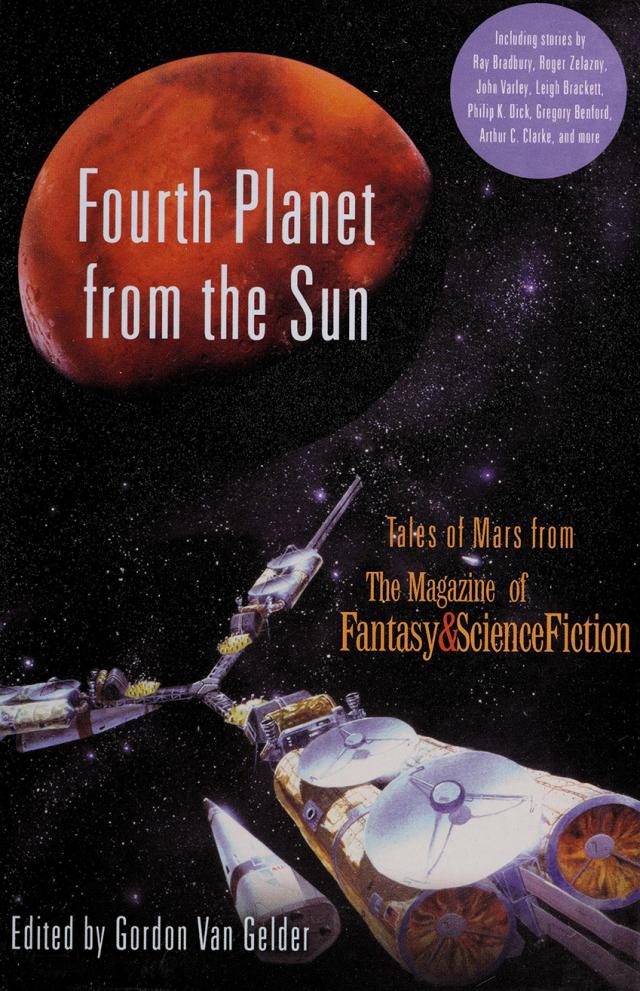


With Mars back in the news again, thanks to the Spirit and Opportunity rovers that landed in January 2004, the time seems right to . . . let you see for yourself how our perceptions and images of Mars have changed over the past 50 years,—from the introduction
Fourth Planet
from the Sun
edited by
Gordon Van Gelder
Long before our robots got there, writers were dreaming about going to Mars. Fourth Planet from the Sun presents twelve tales of the red planet, ranging from planetary romance to scientific realism, by some of the giants of science fiction.
There’s Ray Bradbury’s 1952 story, “The Wilderness,” a mood-piece tracing the last day on Earth of two women who are about to follow their men to the Martian frontier. In “Mars is Ours” by Alfred Coppel, a war on the cold and lonely Martian sands exacts a terrible price from the men who fight it. Arthur C. Clarke imagines “Crime on Mars,” and follows a burglar who fails to consider one
(continued on back flap)
Fourth Planet
from the Sun
Previous anthologies from F&SF
Edited by Anthony Boucher and J. Francis McComas
The Best from Fantasy & Science Fiction (1952)
The Best from Fantasy & Science Fiction: Second Series (1953)
The Best from Fantasy & Science Fiction: Third-Series (1954)
Edited by Anthony Boucher
The Best from Fantasy & Science Fiction: Fourth Series (1955)
The Best from Fantasy & Science Fiction: Fifth Series (1956)
The Best from Fantasy & Science Fiction: Sixth Series (1957)
The Best from Fantasy & Science Fiction: Seventh Series (1958)
The Best from Fantasy & Science Fiction: Eighth Series (1959)
Edited by Robert P. Mills
The Best from Fantasy & Science Fiction: Ninth Series (1960)
A Decade of Fantasy and Science Fiction (1960)
The Best from Fantasy & Science Fiction: Tenth Series (1961)
The Best from Fantasy & Science Fiction: Eleventh Series (1962)
Edited by Avram Davidson
The Best from Fantasy & Science Fiction: Twelfth Series (1963)
The Best from Fantasy & Science Fiction: Thirteenth Series (1964)
The Best from Fantasy & Science Fiction: Fourteenth Series (1965)
Edited by Edward L. Ferman
The Best from Fantasy & Science Fiction: Fifteenth Series (1966)
The Best from Fantasy & Science Fiction: Sixteenth Series (1967)
The Best from Fantasy & Science Fiction: Seventeenth Series (1968)
Once and Future Tales from The Magazine of Fantasy and Science Fiction (1968)
The Best from Fantasy & Science Fiction: Eighteenth Series (1969)
The Best from Fantasy & Science Fiction: Nineteenth Series (1971)
The Best from Fantasy & Science Fiction: 20th Series (1973)
The Best from Fantasy & Science Fiction: 22nd Series (1977)
The Best from Fantasy & Science Fiction: 23rd Series (1980)
The Best from Fantasy & Science Fiction: A 30 Year Retrospective (1980)
The Best from Fantasy & Science Fiction: 24th Series (1982)
The Best Fantasy Stories from The Magazine of Fantasy & Science Fiction (1986)
The Best from Fantasy & Science Fiction: A 40th Anniversary Anthology (1989)
Oi, Robot: Competitions and Cartoons from The Best from Fantasy & Science Fiction (1995)
Edited by Edward L. Ferman and Robert P. Mills
Twenty Years of The Magazine of Fantasy & Science Fiction (1970)
Edited by Edward L. Ferman and Anne Devereaux Jordan
The Best Horror Stories from The Magazine of Fantasy & Science Fiction (1988)
Edited by Edward L. Ferman and Kristine Kathryn Rusch
The Best from Fantasy & Science Fiction: A 45th Anniversary Anthology (1994)
Edited by Edward L. Ferman and Gordon Van Gelder
The Best from Fantasy & Science Fiction: The 50th Anniversary Anthology (1999)
Edited by Gordon Van Gelder
One Lamp: Alternate History Stories from Fantasy & Science Fiction (2003)
In Lands That Never Were: Tales of Swords and Sorcery from The Magazine of Fantasy &
Science Fiction (2004)
FOURTH PLANET FROM THE SUN
TALES OF MARS FROM THE MAGAZINE OF FANTASY AND SCIENCE FICTION
Published by
Thunder’s Mouth Press
An Imprint of Avalon Publishing Group, Inc.
245 West 17th St., 11th Floor
New York, NY 10011
Anthology selection © 2005 Gordon Van Gelder
Introduction © 2005 Gordon Van Gelder
All rights reserved. No part of this publication may be reproduced or transmitted in any form
or by any means, electronic or mechanical, including photocopy, recording, or any information
storage and retrieval system now known or to be invented, without permission in writing from
the publisher, except by a reviewer who wishes to quote brief passages in connection with a
review written for inclusion in a magazine, newspaper, or broadcast.
ISBN 0-7394-5190-1
Book design by Jamie McNeely
Printed in the United States of America
This book is for Scott and Kevin Thomas—
if either of you gets to Mars, send me a postcard
Contents
Introduction
The Wilderness
Ray Bradbury
Mars Is Ours
Alfred Coppel
Crime on Mars
Arthur C. Clarke
Purple Priestess of the Mad Moon
Leigh Brackett
A Rose for Ecclesiastes
Roger Zelazny
We Can Remember It for You Wholesale
Philip K. Dick
Hellas Is Florida
Gordon Eklund and Gregory Benford
In the Hall of the Martian Kings
John Varley
The First Mars Mission
Robert F. Young
The Last Mars Trip
Michael Cassutt
The Great Martian Pyramid Hoax
Jerry Oltion
Pictures from an Expedition
Alex Irvine
Acknowledgments
A BIG THANK-YOU for this book goes to John Joseph Adams, whose contributions have been invaluable. Thanks also to Lisa Rogers, Cristina Concepcion, Russell Galen, Eleanor Wood, Christine Cohen, Barry N. Malzberg, Kay McCauley, Michael O’Connor, Betsy Steve, Kim Stanley Robinson, Byron Abrams, and the Chums on Fictionmags.
What we learn by sending astronauts into space is how humans can survive there. Let’s be honest: We send humans into space for the adventure of it, not for science.
—Lawrence Krauss, Wired, December 2003
Introduction
EVERYONE KNOWS THAT the reason we can observe planet Mars is because sunlight reflects off of it.
My premise for this book was going to be that in the same way the planet reflects sunlight, it reflects humanity back at itself. I had the book sketched out in my head:
From 1908 through the 1940s, Mars reflected dying empires back at us in the form of planetary romances—Edgar Rice Burroughs’s Mars stories and their ilk.
In the 1940s and 1950s, Ray Bradbury reflected Mars back at us like a vision of life in the Midwest United States.
In the mid-1960s, the tradition of planetary romances died out as explorations of inner space took precedence, typified by Philip K. Dick’s contribution to this volume.
Then in the later 1960s and in the ’70s, as the Mariner and Viking flybys brought new scientific information about Mars, our whole concept of the planet was reshaped, with stories of stranded astronauts (like John Varley’s “In the Hall of the Martian Kings”) becoming dominant.
Then in the 1990s, stories about Mars became even more reflective as they concentrated on terraforming Mars—on literally trying to make that planet look more like our own. Kim Stanley Robinson’s Red Mars trilogy is obviously the prime example of this trend.
And here in the new century, the stories seem to have shifted again to focus on celebrity and the media.
Well, guess what. As theories go, it’s not a bad one, but when you look at the data closely, the picture is much more complicated. And with Mars back in the news again, thanks to Spirit and Opportunity, the two Mars Exploration Rovers that landed in January of 2004, the time seems right to collect these various stories and let you see for yourself how our perceptions and images of Mars have changed over the past fifty years.
For this book, I stuck with stories that go to Mars—there are no stories here about Martians invading Earth, nor even stories about making contact with Martians. Those stories, particularly the ones descended from H.G. Wells’s War of the Worlds, strike me as belonging to a somewhat different tradition and deserve a book of their own. (In fact, Kevin J. Anderson edited just such a book in 1996: War of the Worlds: Global Dispatches.) This book’s an outward bound volume, it’s about us going there and not about them coming here. I think it’s filled with adventure, romance, and a lot of great reading. I hope you agree.
The Wilderness
Ray Bradbury
“For years Mr. Bradbury has been writing about Mars, until his readers know that planet as well as the devotees of Sinclair Lewis know Zenith.” Thus wrote our magazine’s founding edito rs, Anthony Boucher and J. Francis McComas, in the second issue of F&SF. Here is a bit more of their perceptive remarks from the header notes to one of Mr. B’s stories:
It is difficult to classify the work of Ray Bradbury. There can be no question of his pre-eminence among our younger short story writers. He’s the “young” master and that’s that. But no two Bradbury fans (ourselves included) can agree on just what type of story Mr. Bradbury tells best. . . . he does everything well.
Simply put, Ray Bradbury’s Mars stories set the standard for many years—they were lyrical prose poems about humanity’s first efforts to colonize the red planet and about the shape-changing Martians they encountered there. The stories were vivid and imaginative; they left an indelible mark on countless readers. Christopher Isherwood said of them that they have “the profound psychological realism of a good fairy story,” and perhaps it’s best now to view them in that manner, rather than by the standard of scientific realism. But remember that fifty years ago, our concepts of Mars were still shaped by Giovanni Schiaparelli’s canals and by Percival Lowell’s strident vision of Mars as a celestial Sahara. For readers who had grown accustomed to Edgar Rice Burroughs’s tales of a heroic earthman dueling green Tharks and wooing the princess of another world, readers who never believed a human would set foot on the Moon, Mr. Bradbury’s Martian tales were far more immediate. This story dates from 1952.
OH, THE GOOD Time has come at last—
It was twilight and Janice and Leonora packed steadily in their summer house, singing songs, eating little, and holding to each other when necessary. But they never glanced at the window where the night gathered deep and the stars came out bright and cold.
“Listen!” said Janice.
A sound like a steamboat down the river, but it was a rocket in the sky. And beyond that—banjos playing? No, only the summer night crickets in this year 2003. Ten thousand sounds breathed through the town and the weather. Janice, head bent, listened. Long, long ago, 1849, this very street had breathed the voices of ventriloquists, preachers, fortune-tellers, fools, scholars, gamblers, gathered at this selfsame Independence, Missouri. Waiting for the moist earth to bake and the great tidal grasses to come up heavy enough to hold the weight of their carts, their wagons, their indiscriminate destinies, and their dreams.
Oh, the Good Time has come at last,
To Mars we are a-going, Sir,
Five Thousand Women in the sky,
That’s quite a springtime sowing, Sir!
“That’s an old Wyoming song,” said Leonora. “Change the words and it’s fine for 2003.”
Janice lifted a matchbox of food pills, calculating the totals of things carried in those high-axled, tall-bedded wagons. For each man, each woman, incredible tonnages! Hams, bacon slabs, sugar, salt, flour, dried fruits, pilot bread, citric acid, water, ginger, pepper—a list as big as the land! Yet here, today, pills that fit a wristwatch fed you not from Fort Laramie to Hangtown, but all across a wilderness of stars.
Janice threw wide the closet door and almost screamed.
Darkness and night and all the spaces between the stars looked out at her.
Long years ago two things had happened. Her sister had locked her, shrieking, in a closet. And, at a party, playing hide-and-seek, she had run through the kitchen and into a long dark hall. But it wasn’t a hall. It was an unlit stair-well, a swallowing blackness. She had run out upon empty air. She had pedaled her feet, screamed, and fallen! Fallen in midnight blackness. Into the cellar. It took a long while, a heart-beat, to fall and she had smothered in that closet a long, long time without daylight, without friends, no one to hear her screamings. Away from everything, locked in darkness. Falling in darkness. Shrieking!
The two memories.
Now, with the closet door wide, with darkness like a velvet shroud hung before her to be stroked by a trembling hand, with the darkness like a black panther breathing there, looking at her with unlit eyes, the two memories rushed out. Space and a falling. Space and being locked away, screaming. She and Leonora working steadily, packing, being careful not to glance out the window at the frightening Milky Way and the vast emptiness. Only to have the long-familiar closet, with its private night, remind them at last of their destiny.
This was how it would be, out there, sliding toward the stars, in the night, in the great hideous black closet, screaming, but no one to hear. Falling forever among meteor clouds and godless comets.
Down the elevator shaft. Down the nightmare coal-chute into nothingness.
She screamed. None of it came out of her mouth. It collided upon itself in her chest and head. She screamed. She slammed the closet door! She lay against it! She felt the darkness breathe and yammer at the door and she held it tight, eyes watering. She stood there a long time, until the trembling vanished, watching Leonora work. And the hysteria, thus ignored, drained away and away, and at last was gone. A wristwatch ticked, with a clean sound of normality, in the room.
“Sixty million miles.” She moved at last to the window as if it were a deep well. “I can’t believe that men on Mars, tonight, are building towns, waiting for us.”
“The only thing to believe is catching our Rocket tomorrow.”
Janice raised a white gown like a ghost in the room.
“Strange, strange. To marry—on another world.”
“Let’s get to bed.”
“No! The call comes at midnight. I couldn’t sleep, thinking how to tell Will I’ve decided to take the Mars Rocket. Oh, Leonora, think of it, my voice traveling 60,000,000 miles on the light-phone to him. I changed my mind so quick—I’m scared!”
“Our last night on Earth.”
Now they really knew and accepted it, now the knowledge had found them out. They were going away, and they might never come back. They were leaving the town of Independence in the state of Missouri on the continent of North America, surrounded by one ocean which was the Atlantic and another the Pacific, none of which could be put in their traveling cases. They had shrunk from this final knowledge. Now it was facing them. And they were struck numb.
“Our children, they won’t be Americans, or Earth people at all. We’ll all be Martians, the rest of our lives.”
“I don’t want to go!” cried Janice, suddenly.
The panic rose in her, with ice and fire.
“I’m afraid! The space, the darkness, the rocket, the meteors! Everything gone! Why should I go out there!”
Leonora took hold of her shoulders and held her close, rocking her. “It’s a New World. It’s like the old days. The men first and the women following.”
“Why, why should I go, tell me!”
“Because,” said Leonora, at last, quietly, seating her on the bed, “Will is up there.”
His name was good to hear. Janice quieted.
“These men make it so hard,” said Leonora. “Used to be if a woman ran 200 miles after a man, it was something. Then they made it a thousand miles. And now they put a whole universe between us. But that can’t stop us, can it?”
“I’m afraid I’ll be a fool on the Rocket.”
“I’ll be a fool with you.” Leonora got up. “Now, let’s walk around town, let’s see everything one last time.”
Janice stared out at the town. “Tomorrow night, this’ll all be here, but we won’t. People’ll wake up, eat, work, sleep, wake again, but we won’t know it, and they’ll never miss us.”
Leonora and Janice moved around each other as if they couldn’t find the door.
“Come on.”
They opened the door, switched off the lights, stepped out, and shut the door behind them.
In the sky there was a great coming-in and coming-in. Vast flowering motions, huge whistlings and whirlings, snowstorms falling. Helicopters, white flakes, dropping quietly. From west and east and north and south the women were arriving, arriving, their hearts neatly tissue-papered in their suitcases. Through all of the night sky you saw helicopters blizzard down. The hotels were full, private homes were making accommodations, tent cities rose in meadows and pastures like strange, ugly flowers, and the town and the country were warm with more than summer tonight. Warm with women’s pink faces and the sunburnt faces of new men watching the sky. Beyond the hills rockets tried their fire, and a sound like a giant organ pressed upon all its keys at once, shuddered every crystal window and every hidden bone. You felt it in your jaw, your toes, your fingers, a shivering.






