

Lost worlds unknown hori.., p.1
Lost Worlds, Unknown Horizons, page 1


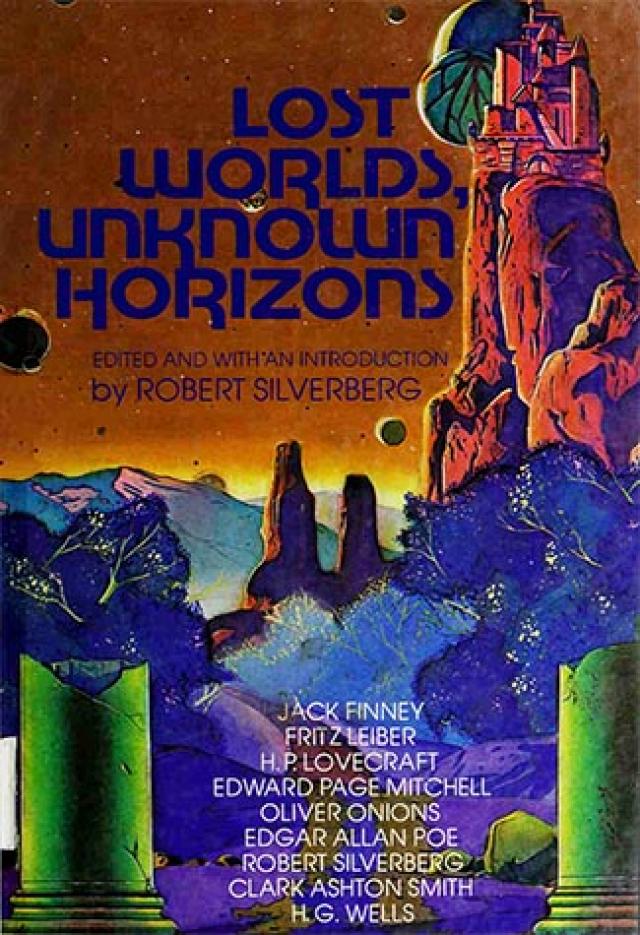
Jerry eBooks
No copyright 2013 by Jerry eBooks
No rights reserved. All parts of this book may be reproduced in any form and by any means for any purpose without any prior written consent of anyone.
No character in this book is intended to represent any actual person; all the incidents of the stories are entirely fictional in nature.
Copyright © 1978 by Robert Silverberg
All rights reserved under International and Pan-American Conventions. Published in Nashville, Tennessee, by Thomas Nelson Inc., Publishers, and simultaneously in Don Mills, Ontario, by Thomas Nelson & Sons (Canada) Limited. Manufactured in the United States of America.
First edition
Library of Congress Cataloging in Publication Data
Main entry under title:
Lost worlds, unknown horizons.
CONTENTS: Wells, H. G. The country of the blind.—Finney, J.
The third level.—Smith, C. A. The city of the singing flame, [etc.]
1. Science fiction, American. 2. Science fiction, English.
I. Silverberg, Robert.
PZ1.L86 [PS648.S3] 813’.0876 78-18345
ISBN 0-8407-6601-7
Lost Horizons,
Unknown Worlds
Acknowledgments
Introduction
Robert Silverberg
LOST WORLDS, UNKNOWN HORIZONS
The Country of the Blind
H.G. Wells
The Third Level
Jack Finney
The City of the Singing Flame
Clark Ashton Smith
The Sunken Land
Fritz Leiber
The Balloon Tree
Edward Page Mitchell
The Doom that Came to Sarnath
H.P. Lovecraft
A Tale of the Ragged Mountain
Edgar Allen Poe
Phantas
Oliver Onions
Trips
Robert Silverberg
Acknowledgments
“The Third Level,” by Jack Finney. Copyright 1950 by Jack Finney. Reprinted by permission of Harold Matson Co., Inc.
“The City of the Singing Flame,” by Clark Ashton Smith. Copyright 1931 by Gernsback Publishers, Inc. Reprinted by permission of the authors estate and its agents, Scott Meredith Literary Agency, Inc.
“The Sunken Land,” by Fritz Leiber. Copyright 1942, 1970, by Fritz Leiber. Reprinted by permission of the author and his agent, Robert P. Mills, Ltd.
“The Doom That Came to Sarnath,” by H. P. Lovecraft. Copyright 1938 by Popular Fiction Publishing Co. Reprinted by permission of the author’s estate and its agents, Scott Meredith Literary Agency, Inc,
“Trips,” by Robert Silverberg. Copyright © 1974 by Robert Silverberg. Reprinted by permission of the author and his agents, Scott Meredith Literary Agency, Inc.
Introduction
Once upon a time the world was very large, and most of it was wholly unknown except to the people who happened to live in the undiscovered places, and maps were full of fantastic guesses about faraway lands, and there were rumors of countries inhabited by dragons and gryphons and men whose heads grew beneath their shoulders. And then everything was discovered—or practically everything—and it was left to the science-fiction writers to supply the fantasies of remote times and spaces that once were provided by geographers and historians.
And so came about this collection of strange and fantastic tales.
Science fiction is a literature of ideas, of social criticism, of technological ingenuity, and of a lot of other things, but mainly, I believe, it is a literature of wonder. Science-fiction writers work in the same tradition as Homer, whose Odyssey is full of eerie monsters and bizarre sorceries; they work in the same tradition as the unknown and much earlier author of the Mesopotamian Gilgamesh legend, that marvelous tale of the man who went seeking the secret of immortality; they supply, for a world much in need of such things, the glow and magic of the unfamiliar and extraordinary.
This book offers, without apology, escape into nine realms of the imagination, into lost worlds and unknown horizons of the mind, into dreams and hallucinations and eeriness. Some science fiction is terribly earnest about analyzing the flaws of society, and some is terribly earnest about predicting the coming developments in computers or organ-transplant techniques, and those are worthwhile and valid kinds of science fiction, but you will not find stories of that sort here. Here, just for once, is science fiction meant chiefly to amuse, divert, delight, and transport. These stories have no more social significance than the ones told by Scheherazade in The Thousand and One Nights—but those stories have given pleasure for a thousand and one years. Perhaps some of these may do so too.
—ROBERT SILVERBERG
The Country
of the Blind
H. G. WELLS
Herbert George Wells (1866-1946) was a man of many facets—historian, social critic, novelist—but he is best remembered today for the immortal science fiction that he produced in a ten-year span around the turn of the century. With such works as The War of the Worlds, The Time Machine, and The Island of Dr. Moreau, he established standards by which all later science fiction must be judged. Many of his short stories deal with fantastic adventure in extraordinary places, and all are exciting and vivid, but of them all I think the famed “Country of the Blind” offers the richest insights into human nature and the most intense experience of the utterly strange.
Three hundred miles and more from Chimborazo, one hundred from the snows of Cotopaxi, in the wildest wastes of Ecuador’s Andes, there lies that mysterious mountain valley, cut off from the world of men, the Country of the Blind. Long years ago that valley lay so far open to the world that men might come at last through frightful gorges and over an icy pass into its equable meadows; and thither indeed men came, a family or so of Peruvian half-breeds fleeing from the lust and tyranny of an evil Spanish ruler. Then came the stupendous outbreak of Mindobamba, when it was night in Quito for seventeen days, and the water was boiling at Yaguachi and all the fish floating dying even as far as Guayaquil; everywhere along the Pacific slopes there were landslips and swift thawings and sudden floods, and one whole side of the old Arauca crest slipped and came down in thunder, and cut off the Country of the Blind for ever from the exploring feet of men. But one of these early settlers had chanced to be on the hither side of the gorges when the world had so terribly shaken itself, and he perforce had to forget his wife and his child and all the friends and possessions he had left up there, and start life over again in the lower world. He started it again but ill, blindness overtook him, and he died of punishment in the mines; but the story he told begot a legend that lingers along the length of the Cordilleras of the Andes to this day.
He told of his reason for venturing back from that fastness, into which he had first been carried lashed to a llama, beside a vast bale of gear, when he was a child. The valley, he said, had in it all that the heart of man could desire—sweet water, pasture, an even climate, slopes of rich brown soil with tangles of a shrub that bore an excellent fruit, and on one side great hanging forests of pine that held the avalanches high. Far overhead, on three sides, vast cliffs of grey-green rock were capped by cliffs of ice; but the glacier stream came not to them but flowed away by the farther slopes, and only now and then huge ice masses fell on the valley side. In this valley it neither rained nor snowed, but the abundant springs gave a rich green pasture, that irrigation would spread over all the valley space. The settlers did well indeed there. Their beasts did well and multiplied, and but one thing marred their happiness. Yet it was enough to mar it greatly. A strange disease had come upon them, and had made all the children born to them there—and indeed, several older children also—blind. It was to seek some charm or antidote against this plague of blindness that he had with fatigue and danger and difficulty returned down the gorge. In those days, in such cases, men did not think of germs and infections but of sins; and it seemed to him that the reason of this affliction must lie in the negligence of these priestless immigrants to set up a shrine so soon as they entered the valley. He wanted a shrine—a handsome, cheap, effectual shrine—to be erected in the valley; he wanted relics and such-like potent things of faith, blessed objects and mysterious medals and prayers. In his wallet he had a bar of native silver for which he would not account; he insisted there was none in the valley with something of the insistence of an inexpert liar. They had all clubbed their money and ornaments together, having little need for such treasure up there, he said, to buy them holy help against their ill. I figure this dim-eyed young mountaineer, sunburnt, gaunt, and anxious, hat-brim clutched feverishly, a man all unused to the ways of the lower world, telling this story to some keen-eyed, attentive priest before the great convulsion; I can picture him presently seeking to return with pious and infallible remedies against that trouble, and the infinite dismay with which he must have faced the tumbled vastness where the gorge had once come out. But the rest of his story of mischances is lost to me, save that I know of his evil death after several years. Poor stray from that remoteness! The stream that had once made the gorge now bursts from the mouth of a rocky cave, and the legend his poor, ill-told story set going developed into the legend of a race of blind men somewhere “over there” one may still hear to-day.
And amidst the little population of that now isolated and forgotten valley the disease ran its course. The old became groping and purblind, the young saw but dimly, and the children that wer e born to them saw never at all. But life was very easy in that snow-rimmed basin, lost to all the world, with neither thorns nor briars, with no evil insects nor any beasts save the gentle breed of llamas they had lugged and thrust and followed up the beds of the shrunken rivers in the gorges up which they had come. The seeing had become purblind so gradually that they scarcely noticed their loss. They guided the sightless youngsters hither and thither until they knew the whole valley marvellously, and when at last sight died out among them the race lived on. They had even time to adapt themselves to the blind control of fire, which they made carefully in stoves of stone. They were a simple strain of people at the first, unlettered, only slightly touched with the Spanish civilisation, but with something of a tradition of the arts of old Peru and of its lost philosophy. Generation followed generation. They forgot many things; they devised many things. Their tradition of the greater world they came from became mythical in colour and uncertain. In all things save sight they were strong and able; and presently the chance of birth and heredity sent one who had an original mind and who could talk and persuade among them, and then afterwards another. These two passed, leaving their effects, and the little community grew in numbers and in understanding, and met and settled social and economic problems that arose. Generation followed generation. There came a time when a child was born who was fifteen generations from that ancestor who went out of the valley with a bar of silver to seek God’s aid, and who never returned. Thereabouts it chanced that a man came into this community from the outer world. And this is the story of that man.
He was a mountaineer from the country near Quito, a man who had been down to the sea and seen the world, a reader of books in an original way, an acute and enterprising man, and he was taken on by a party of Englishmen who had come out to Ecuador to climb mountains, to replace one of their three Swiss guides who had fallen ill. He climbed here and he climbed there, and then came the attempt on Parascotopetl, the Matterhorn of the Andes, in which he was lost to the outer world. The story of the accident has been written a dozen times. Pointer’s narrative is the best. He tells how the party worked their difficult and almost vertical way up to the very foot of the last and greatest precipice, and how they built a night shelter amidst the snow upon a little shelf of rock, and, with a touch of real dramatic power, how presently they found Nunez had gone from them. They shouted, and there was no reply; shouted and whistled, and for the rest of that night they slept no more.
As the morning broke they saw the traces of his fall. It seems impossible he could have uttered a sound. He had slipped eastward towards the unknown side of the mountain; far below he had struck a steep slope of snow, and ploughed his way down it in the midst of a snow avalanche. His track went straight to the edge of a frightful precipice, and beyond that everything was hidden. Far, far below, and hazy with distance, they could see trees rising out of a narrow, shut-in valley—the lost Country of the Blind. But they did not know it was the lost Country of the Blind, nor distinguish it in any way from any other narrow streak of upland valley. Unnerved by this disaster, they abandoned their attempt in the afternoon, and Pointer was called away to the war before he could make another attack. To this day Parascotopetl lifts an unconquered crest, and Pointer’s shelter crumbles unvisited amidst the snows.
And the man who fell survived.
At the end of the slope he fell a thousand feet, and came down in the midst of a cloud of snow upon a snow slope even steeper than the one above. Down this he was whirled, stunned and insensible, but without a bone broken in his body; and then at last came to gentler slopes, and at last rolled out and lay still, buried amidst a softening heap of the white masses that had accompanied and saved him. He came to himself with a dim fancy that he was ill in bed; then realised his position with a mountaineer’s intelligence, and worked himself loose, and after a rest or so, out until he saw the stars. He rested flat upon his chest for a space, wondering where he was and what had happened to him. He explored his limbs, and discovered that several of his buttons were gone and his coat turned over his head. His knife had gone from his pocket and his hat was lost, though he had tied it under his chin. He recalled that he had been looking for loose stones to raise his piece of the shelter wall. His ice-axe had disappeared.
He decided that he must have fallen, and looked up to see, exaggerated by the ghastly light of the rising moon, the tremendous flight he had taken. For a while he lay, gazing blankly at that vast pale cliff towering above, rising moment by moment out of a subsiding tide of darkness. Its phantasmal mysterious beauty held him for a space, and then he was seized with a paroxysm of sobbing laughter . . .
After a great interval of time he became aware that he was near the lower edge of the snow. Below, down what was now a moonlit and practicable slope, he saw the dark and broken appearance of rock-strewn turf. He struggled to his feet, aching in every joint and limb, got down painfully from the heaped loose snow about him, went downward until he was on the turf, and there dropped rather than lay beside a boulder, drank deep from the flask in his inner pocket, and instantly fell asleep . . .
He was awakened by the singing of birds in the trees far below.
He sat up and perceived he was on a little alp at the foot of a vast precipice, that was grooved by the gully down which he and his snow had come. Over against him another wall of rock reared itself against the sky. The gorge between these precipices ran east and west and was full of the morning sunlight, which lit to the westward the mass of fallen mountain that closed the descending gorge. Below him it seemed there was a precipice equally steep, but behind the snow in the gully he found a sort of chimney-cleft dripping with snow-water down which a desperate man might venture. He found it easier than it seemed, and came at last to another desolate alp, and then after a rock climb of no particular difficulty to a steep slope of trees. He took his bearings and turned his face up the gorge, for he saw it opened out above upon green meadows, among which he now glimpsed quite distinctly a cluster of stone huts of unfamiliar fashion. At times his progress was like clambering along the face of a wall, and after a time the rising sun ceased to strike along the gorge, the voices of the singing birds died away, and the air grew cold and dark about him. But the distant valley with its houses was all the brighter for that. He presently came to talus, and among the rocks he noted—for he was an observant man—an unfamiliar fern that seemed to clutch out of the crevices with intense green hands. He picked a frond or so and gnawed its stalk and found it helpful.
About midday he came at last out of the throat of the gorge into the plain and the sunlight. He was stiff and weary; he sat down in the shadow of a rock, filled up his flask with water from a spring and drank it down, and remained for a time resting before he went on to the houses.
They were very strange to his eyes, and indeed the whole aspect of that valley became, as he regarded it, queerer and more unfamiliar. The greater part of its surface was lush green meadow, starred with many beautiful flowers, irrigated with extraordinary care, and bearing evidence of systematic cropping piece by piece. High up and ringing the valley about was a wall, and what appeared to be a circumferential water-channel, from which the little trickles of water that fed the meadow plants came, and on the higher slopes above this flocks of llamas cropped the scanty herbage. Sheds, apparently shelters or feeding-places for the llamas, stood against the boundary wall here and there. The irrigation streams ran together into a main channel down the centre of the valley, and this was enclosed on either side by a wall breast high. This gave a singularly urban quality to this secluded place, a quality that was greatly enhanced by the fact that a number of paths paved with black and white stones, and each with a curious little kerb at the side, ran hither and thither in an orderly manner. The houses of the central village were quite unlike the casual and higgledy-piggledy agglomeration of the mountain villages he knew; they stood in a continuous row on either side of a central street of astonishing cleanness; here and there their parti-colored facade was pierced by a door, and not a solitary window broke their even frontage. They were parti-coloured with extraordinary irregularity; smeared with a sort of plaster that was sometimes grey, sometimes drab, sometimes slate-colored or dark brown; and it was the sight of this wild plastering first brought the word “blind” into the thoughts of the explorer. “The good man who did that,” he thought, “must have been as blind as a bat.”






