Red company first strike, p.1
Red Company: First Strike!, page 1


Books by B. V. Larson:
Star Runner Trilogy:
Star Runner
Fire Fight
Androids and Aliens
Rebel Fleet Series:
Rebel Fleet
Orion Fleet
Alpha Fleet
Earth Fleet
Star Force Series:
Swarm
Extinction
Rebellion
Conquest
Army of One (Novella)
Battle Station
Empire
Annihilation
Storm Assault
The Dead Sun
Outcast
Exile
Demon Star
Starship Pandora (Audio Drama)
Visit BVLarson.com for more information.
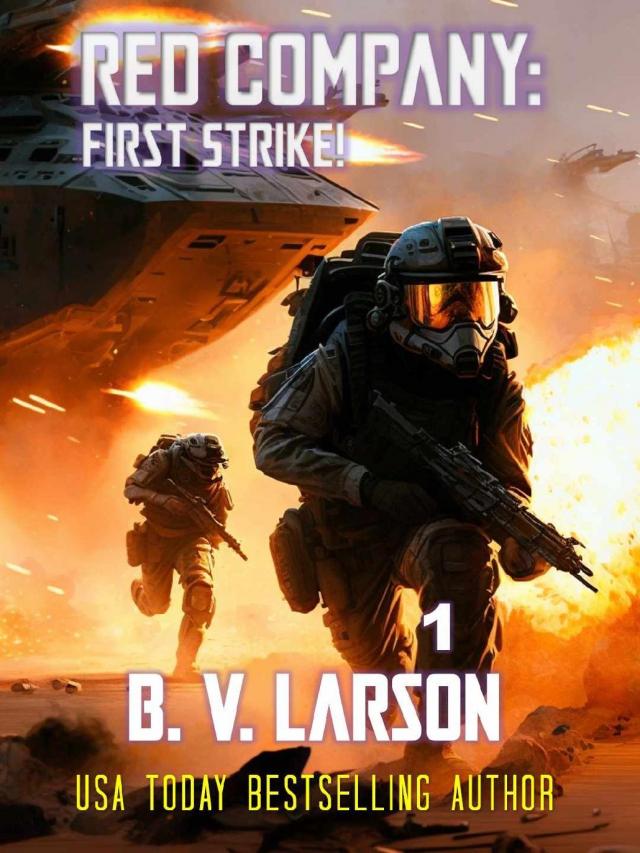
RED COMPANY:
First Strike!
by
B. V. Larson
(Book #1 of the Red Company Series)
The RED COMPANY Series:
First Strike!
Discovery
Contact
Copyright © 2023 by Iron Tower Press, Inc.
This book is a work of fiction. Names, characters, places, and incidents are either products of the author’s imagination or used fictitiously. Any resemblance to actual events, locales or persons, living or dead, is entirely coincidental. All rights reserved. No part of this publication can be reproduced or transmitted in any form or by any means, without permission in writing from the author.
Chapter 1: The Rock-Rat
A group of four Red Company marines marched by. “Marched” was possibly the wrong word, as under the low-gravitational pull of an asteroid, they appeared to be taking a series of leaps. Each step took them farther than an Olympic jumper could fly back on Earth.
My eyes were drawn to them and away from my drill-bot. That was a dangerous thing to do, but I couldn’t help it.
The marines were patrolling the perimeter around the mining rig, looking for danger. They carried stubby laser carbines and wore bulky armored vests. They seemed so superior to me, so organized, well-trained—and above all, dangerous.
Their flying steps soon took them over the horizon of the asteroid and out of sight.
“Starn? Dammit, Starn! Are you listening to me?” It was the foreman. A mean man with a quick temper.
“I’m here, boss,” I said, keying my helmet’s comms. “I’m moving my drill-bot to—”
“Shut up. Get your bot over to pit #3, on the sun-side. There’s a good vein over there. Move your ass.”
“On my way, boss!”
Moving my drill-bot when it was in the middle of a run was easier said than done. I had to practically lift the thing bodily out of the trench it was making. The laser head burned a smoking gash in the rock between my boots before I could get it to shut down. The AI on these things was stubborn.
As I drove the bot toward the new pit the foreman had identified, I had time to ponder my life with all its ups and downs—and it seemed to me that the downs dominated the story.
I’d been born with the cool-sounding name of Devin Starn—and that’s where my luck had ended. I’d spent my childhood navigating the labyrinthine streets of Earth’s sprawling giga-slums, never suspecting that I would one day find myself in the cold expanse of deep space. Yet, here I was today, an indentured, D-Contract rock-rat.
This difficult, dangerous work had begun when I’d been confiscated as an asset related to a long overdue debt. When the state had sold me off as a partial payment, my contract had been snatched up at a bargain price by the shrewd Captain Hansen.
She commanded the mining rig Borag, an aging but formidable vessel that prowled the darkest, most remote corners of the Solar System in pursuit of rare elements. Borag, with her patchwork exterior and mismatched components, had long endured the harsh realities of space mining, but she was our joint ticket to fortune—or so I hoped.
I toiled away during my so-called “days”—a term that felt out of place when the sun’s light was no more intense than a full moon back on Earth—drilling and blasting through the rocky terrain of low-gravity asteroids. My goal wasn’t gold or silver, the metals that had captivated the imaginations of treasure hunters of the past, but rather metals like titanium and beryllium. These elements were far more precious in the unforgiving vacuum of space.
The work was grueling and unrelenting. I alternated between sweating and freezing, as the temperatures swung wildly. The stale air I breathed was a stench accumulating within my solitary spacesuit, an ever-present companion.
Each day, I couldn’t help but think of the steep price I’d paid for my parents’ unknown transgressions. Earth-Gov had never bothered to enlighten me about the nature of their crimes, but the consequences weighed heavily upon my shoulders.
On the positive side, I’d been born on a real planet. That simple fact set me apart from most of the other miners whose contracts were purchased to work aboard Borag. Most of them had elongated bones with muscles like rubber bands. My stocky build was a gift from the gravity I’d grown up with, but it also made me slower and less agile than my colleagues in low-gravity conditions.
As I drove my drill-bot to the brighter side of our chosen rock, I descended into pit #3 with the usual sense of foreboding. The constant danger of ice-slides and cave-ins weighed heavily on my mind. The hum of machinery came through my boots and into my scratched helmet, making it hard to think.
Hours passed uneventfully. I took a deep breath and endured the itching sweat on my brow until the sun finally went to the other side of the rock, at which point I began to shiver. Still, it was ninth-hour, and my shift was winding down. I kept thinking about the four-minute shower I’d allow myself to purchase when it was over.
As I glided my bot over a new hotspot—which glowed like lava after the drill-head was done—I noticed a fellow rock-rat sidling up close on my left.
Charley was working nearby. I didn’t really know him well, but he seemed like an okay guy. I nodded in greeting and Charley returned the gesture.
“Long day, huh?” I said, deciding to break the silence.
“Always is,” Charley replied. “But it beats the alternative, I suppose. It’s the end of the shift, and that always gets a man to thinking.”
I turned my faceplate in his direction and raised an eyebrow, prompting Charley to continue.
“I’m thinking about how I got here,” he continued. “I was young and dumb… fell into gambling and ended up in debt. This was the only way out.”
I nodded in understanding, but I couldn’t help feeling a burning sense of resentment toward the system that had cast us both into this slice of Hell.
“I was different,” I said, “I was a free-loader, a man of the streets.”
Charley laughed at that. “Most homeless losers have cool names to describe themselves,” he said.
“Yeah, well… I thought I was an orphan—but the computers schooled me about that. Apparently, my parents were infamous criminals. When I was arrested by a robo for vagrancy, the state sold me off as a child-asset to pay for the crimes of my parents. Then Captain Hansen bought me cheap, and here I am.”
“Ooooh,” Charley said, squinting warily. “Criminal parents?”
“That’s what I was told. I don’t recall ever having met them in person.”
Charley took a side-step away from me. I knew what that meant. He was thinking about ditching me.
I was used to it. Everyone knew it was a bad idea to associate with dissidents.
He seemed to reconsider, and he paused to speak again. “You’re one of those, huh? Well… I’m sorry to hear that. Guys like us have got to make the best of it, you know?”
I adjusted my drill-bot and kicked it in the side until it started buzzing again. I couldn’t help but wonder if there was an easier way out of this life. A way to break free from the chains that bound me to this remote corner of the Solar System.
When my muscles ached and my eyelids were heavy with exhaustion, the grueling hours in the mines had come down to the final twelfth-hour. My shift was ending, and I hesitantly checked my profit-margins. I found my metered accounts had dropped slightly. That was depressing.
Each month, I was charged an exorbitant amount for the oxygen, heat, water and food I needed to survive. The expenses often left me owing more each paycheck than I could earn from my work. My debt kept moving up and down, but not really going anywhere decisively.
I’d tried all the tricks, of course. Breathing shallowly, skipping meals and showers. I tried to ignore the gnawing hunger in my stomach, the dryness in my throat, and the dull ache in my chest that came with each breath. But the feeling of suffocation was ever-present, a grim reminder of my parents’ mistakes.
These thoughts were interrupted when I heard some indistinct shouts of alarm over my suit radio. I looked up to see one of the mining robots malfunctioning, its arms flailing wildly as it careened toward Charley. The machine rammed into him, but I was spared the awful crunch since there wasn’t any air around us to transmit the sound.
Without a second thought, I rushed toward Charley. I managed to reach him before the robot could finish him. I grabbed hold of the robot’s arm and strained against its wild motion, my muscles screaming in protest.
Charley lay on the spiny rocks, his leg trapped under a slab that would have weighed more than a truck on Earth. The robot’s treads were still moving, pressing down on his chest. His eyes were closed, and he looked pale and cold inside his cracked helmet.
I gritted my teeth and strained against the robot’s motors. My muscles burned with the effort. I could feel the metal threatening to cut into my suit, but I refused to let go. With a final burst of strength, I lifted the robot off Charley’s injured body and tossed it into a spin. It almost reached orbit, still flailing and casting weird shadows and flashing reflections from our distant sun.
Charley gasped for air, and his eyes fluttered open. “Thanks,” he croaked.
I nodded, with my heart racing from the adrenaline. I could feel the sweat pouring down my face.
Charley peered up at the robot, which was still flying higher. “A normal rock-rat couldn’t have done that,” he said. “Too much inertia—and those bots have magnets and other tricks to get traction, you know.”
He coughed and wheezed, and I told him to take it easy. The other miners rushed over to see what had happened, and I couldn’t help but feel a sense of pride. Despite the odds, I’d managed to save Charley’s life.
I watched as the other miners gathered around me, their expressions a mixture of appreciation and worry—but the moment was short-lived. The foreman approached, and his expression was grim.
“What the fuck is this? A twelfth-hour strike?”
“No, sir!” the miners all replied in unison, and they did their best to melt away and return to work. Strikes were illegal, and the punishments were harsh if the charges were upheld by an AI judge.
“You two are way behind on your quotas of ore,” the foreman said, checking our numbers.
We apologized and assured him we’d work harder. He was about to let us off with a write-up and a warning—when he caught sight of the drill-bot spinning overhead.
At that point, his voice became wrathful. My heart sank. I’d been working harder than ever, but it never seemed to be enough.
“That’s company property, Starn. I know Charley didn’t throw that thing up there—he’s no dirt-kicking Earther like you are. You know the punishment.”
“Yes, boss.”
The foreman pulled out a shock-rod. I gritted my teeth as he jabbed the crackling stick into my side, sending a surge of electricity through my body. I fell to my knees, gasping for air. The other miners scuttled away to safety.
But I knew the routine. After six or seven zaps—I lost count along the way—I got up, ignoring the pain, and returned to my work. The foreman hauled Charley onto his back like a sack of rocks and carried the groaning, injured man back to the hulking ship.
After I’d corralled the drill-bot, I penetrated deeper into the surface of the asteroid, and I actually found a rich vein of titanium. That was something, at least.
My thoughts turned to Charley. I figured I knew what would happen to him. Charley would be hauled back to the lowest hold on Borag for processing. I’d seen it happen to others before, and I knew no miner wanted to endure that.
Despite the danger and the uncertainty, I continued to work, my mind consumed with hopes of riches. I knew that was the only way to break free from the chains that bound me to this life.
When my shift was nearly done, the titanium had really come in. I’d paid for at least three days of my own upkeep. That was a big win to my way of thinking. This new rock was a bonanza. If we spent a month or more here, and the metals didn’t run out…
My thoughts snapped back to the here and now when I caught a glimpse of Borag’s captain, a no-nonsense woman named Captain Elsa Hansen. She looked stern and unapproachable, and she had a reputation for being tough on her crew.
Next to her was Oswald Blackwood, the ship’s chief accountant. Blackwood was a tall, spare, stick of a man. They said his splayed feet had never touched the dirt of a real planet, and from the look of him, I believed the rumors.
“Devin Starn?” Blackwood said.
“That’s me, sir.”
“It’s come to our attention that you were involved in a work-related accident.”
I felt the sweat break out on my stubbly temples despite the cold in my half-heated suit. “Not exactly, Mr. Accountant, sir. I tried to—”
Blackwood threw up a webwork of overly-long fingers, and I instantly stopped my stammered response. The accountant flipped open a computer that glowed blue light into his faceplate. His eyes ran over the numbers as did his fingers. He shook his head grimly.
“The company has experienced a loss, today. Unscheduled maintenance on a drill-bot. Spare parts are required, plus labor costs incurred. I’m putting you down as accountable.”
“What?” I squawked. “It was an accident, sir. All I did was try to save Charley.”
Captain Hansen watched all this quietly. She was listening without interrupting on anyone’s behalf.
Blackwood pursed his lips. “Are you expecting us to eat this entire charge?” he said, shaking the computer at me. “It’s more than you’re likely to earn in a lifetime, but you’re going to do your best!”
With that, he turned away from me. I was desperate, so I called him back. “It wasn’t my fault, sir. The machine malfunctioned. All I did was try to help save a man’s life.”
Slowly, the accountant turned back to face me. “Is that right? Are you aware that the man in question is also in a state of insurmountable debt? You’re both liabilities on every cell of my spreadsheets!”
“But sir, can’t you see your way to handling this differently? I can’t take on more debt—I just can’t.”
The man narrowed his eyes, and he opened his mouth to shout “no” but another man stepped forward. It was my own foreman.
“There is a way…” he said, looking slightly excited. “He can take punishment instead.”
“That won’t pay for anything!” Blackwood raged.
“No, but if we mark this down as an act of defiance and violence, instead of an accident, it’ll go into a different category, won’t it?”
The accountant thought that over, and he brightened. “You’re right. A different category… with a different source of funding… we’ll call it vandalism. I like the way you think, Foreman.”
Blackwood turned back to me, and his face had a predatory cast to it. “Mr. Starn, you will be disciplined for your gross acts of violence directed toward company property. When do you choose to take your medicine?”
I shrugged. “My shift is over—and I’ve had a good day as far as ore goes. Let’s do it now.”
With a grim expression, the foreman glanced at Captain Hansen. She’d been quiet all this time, but she was listening closely. She nodded her head to the foreman.
The man lifted his shock-rod, and he turned up the power all the way—then he jabbed me in the ribs with it.
The pain was indescribable. The shocks I’d received earlier were nothing like this. It was like comparing tiny arcs of static to shoving a wet finger into a light socket. My eyes blinked on their own, and my body folded up. My legs were water. I fell gently due to the low gravity.
“Again,” said the accountant, and the foreman obliged.
He gave me another one, and I could taste metal and blood in my mouth. I’d bitten my tongue.
“Again.”
This time, I blacked out for a moment—at least, I thought it was only a moment.
“He’s aware again,” Blackwood said in a bored tone. “What an obstinate brute… keep going.”
I grunted in fear and almost pissed myself—but the next shock never came.
To my surprise, I heard Captain Hansen’s voice speak for the first time today. “Enough,” she said firmly. “That’s an order.”
I couldn’t believe what I was hearing. The foreman had always been merciless, punishing miners until they fell unconscious—or worse. But here was the captain of the Borag rig, ordering him to stop.
Blackwood complained that I hadn’t yet fallen unconscious. “Insurance might reject our claim!”
But Captain Hansen insisted. “We don’t need any more deaths on this ship,” she said, “not on this shift, anyway.”
Her voice left no room for argument. They walked back to the dark mass which was Borag. I lay there, gasping on the rocks for a time, with my entire body aching.
For the first time in a long while, I felt a glimmer of hope. Sure, I’d suffered a bit. But I’d kept my gains today. Maybe, just maybe, there was a way out of this life, a way to escape the brutal cycle of debt and servitude.