Creators of science fict.., p.1
Creators of Science Fiction, page 1


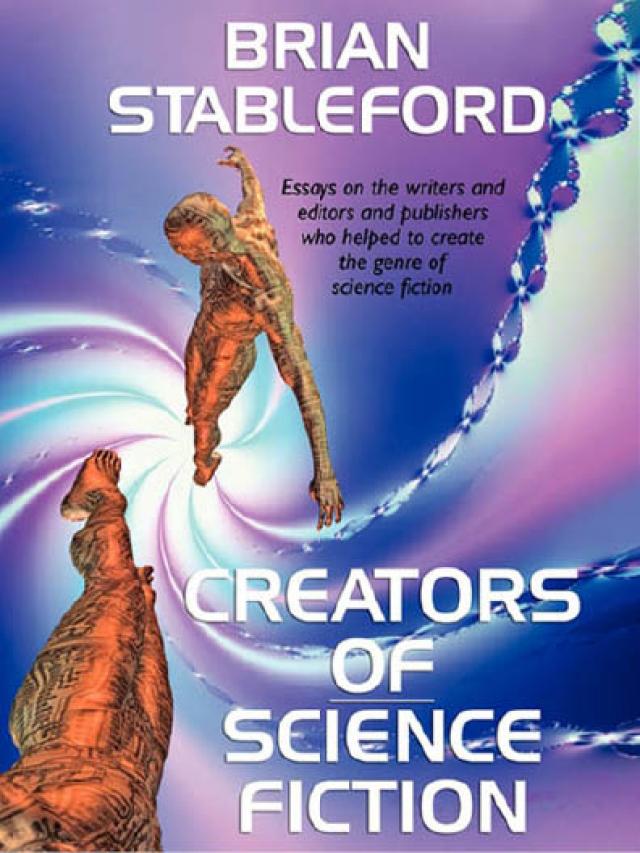
Copyright Information
I.O. Evans Studies in the Philosophy
and Criticism of Literature #50
ISSN 0271-9061
Copyright © 1995, 1996, 1997, 1998, 1999, 2002, 2010 by Brian Stableford
Published by Wildside Press LLC
www.wildsidebooks.com
Introduction
Creators of Science Fiction was a title I first used on an occasional series of articles published in the British magazine Interzone in 1996-98, following a request from the editor, David Pringle, who thought that it might be a good idea to introduce his readers to the history of the genre. His readers were far from unanimous in their response to the series, which was eventually abandoned. Because some of the articles have already been reprinted in earlier Borgo Press collections, or have too considerable an overlap with others that have been reprinted, only four are reproduced here; the article on E. E. “Doc” Smith was number 7 in the series and appeared in issue no. 111 (September 1996); the article on James Blish was number 8 and appeared in issue no. 117 (March 1997); the article on Hugo Gernsback was number 10 and appeared in issue no. 126 (December 1997); and the article on John W. Campbell Jr. was number 11, appearing in issue no. 133 (July 1998).
It was probably not surprising that many of the readers of Interzone in the late 1990s were not much interested in the history of the genre, simply because it had become impractical by that time to take such an interest in any reasonably comprehensive fashion, at least in Britain. It was much easier in the early 1960s, when I began to read sf avidly. At that time the labeled genre had only just reached the end of the phase of its evolution when it was largely contained in magazines; second-hand digest magazines were easy to come by and relatively cheap, and much of the significant work from the pulp magazines was in the process of being reprinted in paperback by such publishers as Ace. The British Science Fiction Association had a postal lending library that included both books and magazines, and Sam Moskowitz had published series of articles in the magazines about the most significant writers within the labeled genre and their most important precursors, which served as an elementary guide to the most interesting materials. Anyone prepared to devote the time could, therefore, familiarize themselves with the entire history of sf, as well as keeping up with newly-published material, within a decade. Thirty years later there was not only twice as much historical material to catch up on, but the availability of the earlier material had been considerably reduced; little of it was being reprinted, second-hand bookshops were in steep decline and the half of the BSFA library that had not been consumed by fire had been removed to the vaults of Liverpool University Library as the nucleus of the Science Fiction Foundation collection, available only on-site to accredited scholars.
Given all that, it is not obvious that this collection, which attempts to put the remaining articles from the original series into a broader context, reaching back to the origins of speculative fiction and forward to more contemporary material, can be of overmuch interest to anyone but earnest academics. Indeed, now that textual science fiction no longer exists as a popular genre—save as a vestigial appendix of a fantasy genre that is itself in terminal decline—it is not obvious that there will be any significant further interest outside the groves of Academe in any of the material covered herein. Even so, I feel entitled to hope that it might qualify as something more than a mere elegy, if only on the grounds that text constains imaginative possibilities that TV and cinema will never be able to duplicate, by virtue of their inability to go beyond appearances, and will therefore always constitute a unique resource for the comprehensively alienated. If the comprehensively alienated are not willing to learn to read, in the full sense of the term, who will be?
“Frankenstein and the Origins of Science Fiction” first appeared in Anticipations: Essays on Early Science Fiction and its Precursors ed. David Seed, published by Liverpool University Press in 1995. the article on Edgar Allan Poe’s “Sonnet: To Science” is based on an article in Masterplots II: Poetry Series Supplement edited by John Wilson & Philip K. Jason, published by Salem Press in 1998. The article on Camille Flammarion’s Lumen is derived from the introduction to my translation of that work, issued by Wesleyan University Press in 2002. The articles on Verne and Wells both adapt material from other articles, but neither has been published in their present form before, although the Wells aricle was once read at a “conference” accompanying an exhibiton of children’s books in Paris. The remaining articles first appeared in Science Fiction Writers, 2nd Edition edited by Richard Bleiler, published by Scribner’s in 1999.
Frankenstein and the Origins of Science Fiction
Frankenstein is one of those literary characters whose names has entered common parlance; everyone recognizes the name and uses it casually. The recognition and the usage are often slightly uncertain—most people know the name from the film versions, which are significantly different from the book, and some people have to be reminded that Frankenstein is the name of the scientist, not the monster that the scientist made—but this uncertainty is not entirely inappropriate to a work whose implication and significance are rather problematic.
The popularity of Frankenstein, both as a literary classic and as a fuzzy set of ideas, bears testimony to the remarkable vividness of Mary Shelley’s vision, but it also reflects the protean quality of its central motifs, which can be interpreted in several different ways so as to carry several different messages. The most common modern view of the story—aided and perhaps sustained by Boris Karloff’s remarkable performance in the 1941 film version and its sequels—is that it is an account of the way in which “monstrousness” arises, involving diseased brains, inadequate control over one’s actions and resentment against the unthinking horror with which most people react to ugliness. The most common view based on the book alone sees it as an allegory in which a scientist is rightly punished for daring to usurp the divine prerogative of creation. A closely-related interpretation regards Victor Frankenstein as an archetypal example of a man destroyed by his own creation; in this view the story becomes a central myth of the kind of technophobia which argues that modern man is indeed doomed to be destroyed by his own artifacts—and that such a fate, however tragic, is not undeserved. There are, of course, more convoluted interpretations of the text to be found in the voluminous academic literature dealing with the story. Among the most widely-cited are accounts that see the story as a kind of proto-feminist parable about the male usurpation of the female prerogative of reproduction, and accounts that see it as an allegory of the evolving relationship between the ancien régime and the emergent industrial working class.
So far as can be ascertained, Mary Shelley does not appear to have had any of these theses in mind when she wrote the book, but champions of these various meanings are usually content to interpret them as the result of a coincidence of inspirational forces in which the author’s role was that of semi-conscious instrument. Support is lent to this view by the fact that Mary Shelley was only nineteen years old when she completed Frankenstein, and by the fact that all her other books—with the partial exception of the majestically lachrymose jeremiad The Last Man (1826)—failed to excite the contemporary audience and are now rarely read or studied. However, the fact remains that Frankenstein is one of the most powerful stories produced in the course of the last two centuries and that it has better claims than any other to have become a “modern myth” (whatever one understands by that phrase).
* * * * * * *
Frankenstein is often called a Gothic novel, on the grounds that the popular horror stories of its day mostly shared a set of characteristics which justified that label, but it ought not to be thus classified on the grounds of its contents. Despite certain similarities of method and tone, its subject matter is very different from that of the classic Gothic novels. Horace Walpole’s definitive The Castle of Otranto (1795), Ann Radcliffe’s The Mysteries of Udolpho (1794), Matthew Gregory Lewis’s The Monk (1796), and Charles Maturin’s Melmoth the Wanderer (1820) all involve sinister ancient edifices, evil conspiracies, hideous apparitions (invariably interpreted as supernatural, though sometimes ultimately rationalized), the threat of sexual violation, and intimations of incest. The pretence that Frankenstein—which employs none of these motifs—belongs to the Gothic subgenre serves mainly to obscure the remarkable originality of its own subject-matter, which is broader and more forward-looking.
Victor Frankenstein might be regarded as a distant literary cousin of the seemingly diabolical—or, at least, diabolically-inspired—villains of the classic Gothic novels, but his personality and his ambitions are very different. Although he takes some early inspiration from occult writings, of a kind that the inquisitorially-minded might regard as the devil’s work, he undertakes a decisive change of direction when he decides that it is modern science, not ancient magic, that will open the portals of wisdom for scholars of his and future generations. By virtue of this move, Frankenstein began the exploration of imaginative territory into which no previous author had penetrated (although that was not its initial purpose). For this reason, the novel is more aptly discussed as a pioneering work of science fiction, albeit one that was written at least half a century before its time, and one that does considerable disservice to the image of science as an instrument of human progress.
It is entirely appropriate that Brian Aldiss should have worked so hard in Billion Year Spree to establish Frankenstein as the foundation-stone of the modern genre of
Ambivalent attitudes to science are not particularly unusual in works of speculative fiction. A great deal of the fiction nowadays categorized as science fiction is horrific, and much of it is born of a fear, or even a deep-seated hatred, of the scientific world-view, whose acknowledged intellectual triumph over older concepts of natural order seems to many observers to be unedifying and undesirable. Give this, it would not necessarily be inappropriate to trace the origins of the genre back to a science-hating ancestor—but it is not at all clear that the author of Frankenstein set out with the intention of attacking or scathingly criticizing the endeavors of science, even though many modern readers think that the text carries a bitterly critical moral.
Mary Shelley’s life story suggests strongly that she was not the kind of person who might be expected to produce an anti-scientific parable. Her actions and the opinions she held in the years which led up to the writing of Frankenstein were such that one suspects that she might have been rather distressed to discover that so many readers interpreted her work in that way, although it must be admitted that she did little to discourage such an interpretation. If, however, one assumes that she had no such intention, there remains the problem of explaining how and why the book turned out to have such a semblance at all.
The full title that Mary Shelley gave to Frankenstein is Frankenstein; or, The Modern Prometheus. In attempting to assess the significance of this choice it is necessary to bear in mind her beloved husband’s fascination with the character of Prometheus. To a committed atheist like Percy Shelley, Prometheus was a great hero whose condemnation to be chained to a rock throughout eternity while eagles came daily to devour his perpetually-regenerated liver was firm proof of the horrid unreasonableness and downright wickedness of godly tyrants. Shelley knew quite well that the atheism he proclaimed so loudly and the free love that he and Mary preached and practiced so brazenly were—in the eyes of his enemies—tantamount to Satanism, but like William Blake before him he was fully prepared to champion Satan himself, let alone the safely-obsolete Prometheus, as a revolutionary light-bearer unjustly slandered and condemned by a monstrous God. To Percy Shelley—and to Mary too, at least while Percy lived—no modern Prometheus could possibly be reckoned a villain, and any terrible fate a modern Prometheus might meet must be reckoned as a tragedy, not an exercise of any kind of justice, divine or otherwise.
Given all this, it is unlikely in the extreme that a book that Mary Shelley elected to call The Modern Prometheus was planned as an assault on the hubris of scientists, or as a defense of divine prerogative. It is true that Mary Shelley added a new introduction to the revised edition of the book issued in 1831, in which she seemed not unsympathetic to the demonization of Frankenstein, and also to the notion that she had been a mere instrument of creative forces for whose produce she was not to be held responsible, but this was nine years after Percy Shelley’s death—which circumstance had forced her to compromise and make her peace with all the tyrannies of convention that he was able to despise and defy quite openly. (In Victorian times, even the most determinedly heroic woman had far less leeway than a man.) Even if the 1831 introduction can be reckoned sincere—and it almost certainly cannot—it must be reckoned the work of a person who bears much the same relation to the author of Frankenstein as the humbled Napoleon who came back from Moscow bore to the all-conquering hero who had set out.
The fact remains, however, that whether Frankenstein’s fate was intended to be an awful warning to scientists or not, it certainly looks that way. How could this have come about?
* * * * * * *
The text of Frankenstein begins with a series of letters written by the explorer Robert Walton, who has been trying to navigate his ship through the Arctic ice in the hope of finding a warm continent beyond it, akin to the legendary Hyperborea. Modern readers know full well that this was a fool’s errand, but that was not at all certain in 1818. Thus, although Walton’s situation is clearly symbolic—one of the Gothic conventions that Frankenstein does adopt is that the weather is symbolic of human emotion, so his entrapment in the ice signifies that Walton’s noble ambitions have unfortunately alienated him from the warmth of human companionship—it should not be taken for granted that Mary Shelley saw him as a lunatic who should have known better. Nor should we assume that Walton’s encounter with Victor Frankenstein, who is similarly lost in the ice-field, and in whom Walton recognizes a kindred spirit, was, in her eyes, a meeting of damned men.
Victor’s story, as regretfully told to Walton, is essentially that of a man who once had “everything” but lost what he had through desiring even more. The “everything” that he had included material goods, but its most precious aspects were friendship and love, embodied in his relationships with Henry Clerval and his cousin Elizabeth. He explains that his ambitions became inflated when he left home for university, where he became enamored of the grandiose dreams of Renaissance magicians like Paracelsus and Cornelius Agrippa. One of his teachers dismissed this fascination with frank contempt, but another pointed out that modern scientists were beginning to achieve results even more marvelous than those which the optimists and charlatans of earlier eras had claimed. Victor then made his crucial intellectual move, turning his attention to science—specifically to the science of electricity, the “vital fluid” whose implication in the mechanics of muscular movement had recently been demonstrated—as a possible means of achieving an unprecedented victory over the greatest of all tyrants: death.
(It is worth noting here that Mary Shelley, even at the tender age of nineteen, had good cause to be preoccupied with the oppressions of this particular tyrant. Her mother’s glittering intellectual career had been cut short when she died shortly after bearing Mary, and Mary’s first child by Shelley had already died before the fateful night at the Villa Diodati that set in train the sequence of events that ultimately led to the writing of Frankenstein. The death of Shelley’s first wife Harriet—who drowned, probably by suicidal design, while Mary was engaged in the writing of the book—freed Shelley so that he and Mary could marry. This last episode presumably added an uncomfortably guilty ambivalence to her preoccupation with mortality.)
Victor explains to Walton that, while he was completing his experiments in resurrection, he became withdrawn and intellectually isolated, no longer able to find any joy in social intercourse. This process reached a frightful climax when the work was finally complete; the patchwork man that he had made had only to open a cold eye for Victor to be suddenly overcome by repulsion at what he had wrought. When the monster departed in confusion, Victor gladly reverted to type, renewing his relationships with his friend and his family—who gratefully nursed him back to health when he fell terribly ill.
One of the more ingenious academic interpretations of the plot suggests that, from this point onwards, much—if not all—of what Victor tells Walton is a chronicle of hallucinations, and that the monster who subsequently appears to him is a projection of his own personality: his own doppelgänger. Although this is, at least superficially, the most bizarre of the various academic reinterpretations, its adherents rightly point out that it makes condiserably more sense than a literal interpretation of the puzzling events that follow in Victor’s narrative.