

The wild wood, p.1
The Wild Wood, page 1
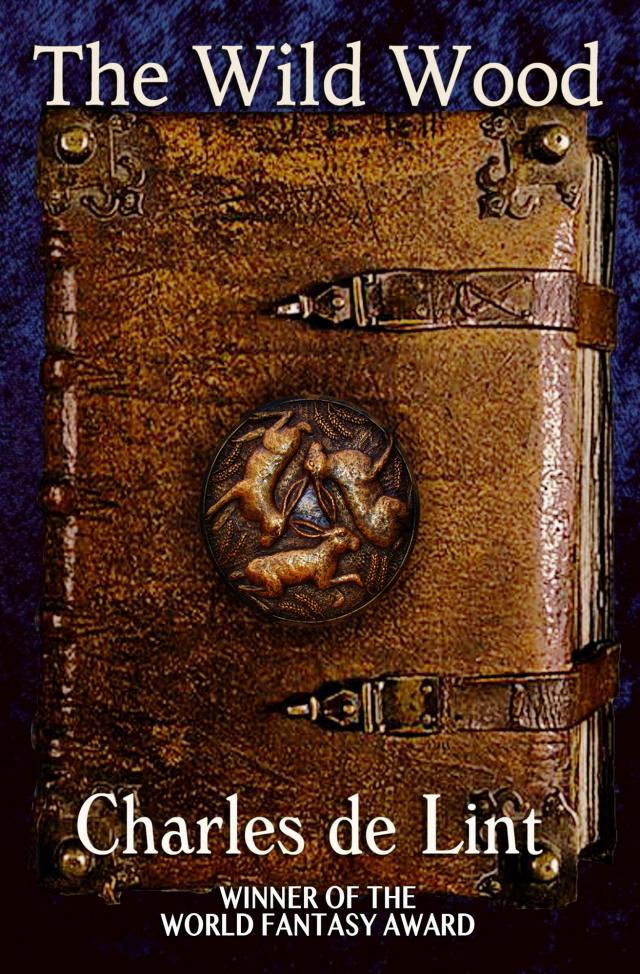


The Wild Wood
Charles de Lint
TRISKELL PRESS
P.O. Box 9480
Ottawa, ON
Canada K1G 3V2
www.triskellpress.com
* * *
First published as part of Brian Froud’s Faerielands series; Bantam/Spectra, 1994. This Triskell Press edition published in 2019.
Copyright © 1994 Charles de Lint
Cover design by MaryAnn Harris
* * *
eISBN 978-0-920623-88-6
* * *
All rights reserved. This book or any portion thereof may not be reproduced or used in any manner whatsoever without the express written permission of the author or publisher except for the use of brief quotations in critical articles or reviews.
* * *
This is a work of fiction. Names, places, businesses, characters and incidents are either the product of the author’s imagination or are used in a fictitious manner. Any resemblance to actual persons living or dead, actual events or locales is purely coincidental.
Contents
A note from the author
1. Falling
2. The Hollow Woman
3. Flight
4. Dry Wash
5. Vancouver Airport
6. Log Cabin Home
7. Anima
8. Dreamtime
9. Chopping Wood
10. Granny Wis’om
11. Broceliande
12. Mask of Leaves
13. Butterfly Effect
14. Lia
Mailing list
About the Author
Other Books by Charles de Lint
for Donna Gordon
whose artistic talent
is equaled only by
her generous spirit
A note from the author
It’s been 25 years since The Wild Wood was first published as a lovely little Bantam Books hardcover. That edition was profusely illustrated with Brian Froud's drawings, which I got to choose in advance, and his gorgeous art set the mood for me as I was writing the book.
Back then, the ecological crisis wasn't at the forefront of most people's minds, but Froud understood the need to sound the alarm. So he conceived the Faerielands series, created a pile of beautiful art, and invited myself and three other fantasy authors to gather together, choose our favourite pieces, and write stories inspired by his drawings with some focus on environmental issues.
Here we are, a quarter century on, and the ebook you hold in your hands lets the narrative jump from screen to eye. The words are the same, only the delivery system has changed. Sadly, what hasn’t changed is the desperate state of the world. What seemed like an emerging concern in the early '90s is now reaching catastrophic proportions. Awareness has grown a great deal, so reading the story now, all these decades later, the text of The Wild Wood can sometimes overstate the obvious. We are far more tuned in to what's happening, and yet a large segment of the world still denies climate change, are unwilling to make any adjustments in their lifestyle, and prefer to ignore the science because it will inconvenience them.
I'm not sure how dire the signs have to get before these people and corporations start to "get it," but for those of us already on board, as we change our own harmful habits, let's keep up the pressure on our political leaders to make protecting the environment an absolute priority.
Special thanks to MaryAnn for her usual excellent job of fine-tuning the story and for yet another excellent cover.
We live in trying times so I hope that you, my loyal readers, persevere in bringing some hope and kindness into the world, and remember to take care of one another.
* * *
—Ottawa, Autumn, 2019
We have loved the stars too fondly
To be fearful of the night.
—inscription on a New England tombstone
* * *
Animula, vagula, blandula,
Hostes, comesque, coroiris;
Quae nunc alibis in loca,
Pallidula, rigida, nudula?
* * *
(Sorry-lived, blithe little, fluttering sprite,
Comrade and guest in this body of clay,
Whither, ah! whither, departing in flight,
Rigid, half-naked, pale minion, away?)
—attributed to Emperor Hadrian on his death bed
* * *
Go and wake up your luck.
—Persian proverb
1
Falling
Like music entangled in a thorny embrace, leaf-sigh, branch-rustle. It has no melody, but the underlying rhythm, the tap-tap-tap of stick against stick against twig against hollow wood, holds a kind of tune. Not one I can hum—can't hold a tune anyway. But I almost recognize it. It's the voice of blood, slow sap blood, quick wind blood, underground river, underskin river, all mingled.
It leaves me confused.
I look at my hands and see fur, see scale, see bark, see rough stone, smooth pebble. Shadow. Light. All a part of the music, the melody that has no melody.
I turn, meaning to reach out and part the grass, to look away from the forest that has snared me with its fey music, but the sound is in my underskin river now and I can't move.
This should be a dream. It has the texture of dream, the impossible quality that belongs to dream.
But I'm not asleep, abed, a-dream. I'm afield, bright broad day all around me, dry grass stirring without a wind, music drumming between my temples where my underskin river flows so close to the skin. It pulses in the hollow of my throat, shivers quicksilver echoes up and down my spine until all my nerve ends are trembling with expectation, as though the forest is my lover and I'm anticipating his touch.
I imagine…
No, I am…
Transformed. Transported.
Not asleep, not drugged either, except by unknown fable, by unfamiliar myth, by reasoning waking dream. Held fast in a glamour. Part of the play, but I never auditioned, never read for the part, never wanted it, but have been put on stage all the same.
I see her then, part of the forest, apart from it, like a tree suddenly given motion, taking one step, another, a sidling, indirect, corner-of-the-eye secret movement.
Leaves and burrs and small, pale white flowers in her luxurious Pre-Raphaelite hair, chestnut brown, turned-earth brown, bark and bough and autumn leaf brown.
Dress a rich brocade that's at once too perfect for forest wear and tattered and thorn-tugged and torn.
One visible eye, hazel-brown and green, swallows light, shines with shadow. Her left hand holds the mask to her face covering the other eye and her features. The mask is friendly and frightening all at once, maple leaves, autumn red, folded and bound together. I don't have to touch it to know that it will have the texture of lacquered wood.
Her right hand holds an open book on her lap—book or folds of cloth that are book-like, or book growing from cloth, I can't tell, turned about so as to show me what lies on its pages—and in the book, a picture of the same masked woman, holding the same book…
Vertigo puts my head between my knees. When the dizziness finally passes, when I finally look up again, nothing has changed, except the book draws my gaze more firmly than before.
It's old, this book. I know that much. Instinct tells me it’s a found object, lost among roots and moss, once. It smells old, not library musty, but like a long-fallen snag. Cover made of bark or skin or some curious combination of the two, cunningly bound with leaf and leather, feather and thorn, spider web and vine. Inlaid in the center of the cover is a triskelion made up of three hares, ingeniously rendered Escher-like so that each of the hares' right ears makes up the left ear of the one next to it.
The open pages—are they pages? In the book, the picture woman lifts her head from the page and I see that she, too, holds something. Is it a child, a baby?
No. I won't look. I can't look at the baby.
My heart constricts with pain and I focus instead on the trees behind her. The picture forest is older and thicker than the woods I know, fat boles and sinewy bough patterns against the sky. There are faces in the shadows and the faces have shapes inside them and more forest and skinny limbs and long fingers that become twigs and branches and within the shadows of the branches are more faces.
The picture in the book has trapped my gaze into ever downwardly spiralling fractals. I know the forest, the faces, the figures, will go on forever. No matter how far my sight takes me, there will be no end to the parade.
I try to tear my gaze from the book, but the book is all there is now. I'm inside its pages. I stand on a tipped-in painting and can see where the roots grow from two dimensions into three. They tangle about my feet, pierce the pages of the book, are thick with moss and fungi and deep earth scents and faces, always the half hidden, fox-thin faces.
I focus on the trunk of the closest tree. The fat, barked bole is enormous, three, four, ten times the girth of anything in my wood. The grain of the bark draws my gaze upward to where the broad spread of the branches grow as do the roots, from printed image, through the pages, up into the sky—
My sky or painted sky?
My ears ring and my nose is blocked, as though the air pressure has suddenly changed. The physical discomfort allows me to drag my gaze away from the sky, down again, along the grain of the bark, faces hidden in the whorls and knotholes, tiny twig fingers reaching for me, tugging like small sharp thorns at my sweater, at my jeans, at the laces of my shoes…
"You must remember."
The wom
I look to her. The child is gone. The book is gone—
You're inside the book now, I calmly remind myself, as though it were a common, everyday occurrence.
—but the mask remains. She begins to move it aside, but I know I don't want to see her face because I'm afraid I'll see my own features looking back at me. I focus instead on the crystal that hangs from a black silk ribbon at the hollow of her throat, but it points downward and my gaze continues in the direction it points, falling into the folds of her brocade dress where the pages of the book are confused with the thick cloth so that I still can't tell one from the other, where forest mingles with marsh and seashore, with mountain scarp and deep ocean and desert hill…
She speaks again, but now the words are as foreign as her accent and they make no sense. I only know that I am falling into the flickering worlds that are caught in the folds of her clothing. Twig fingers are helping me along, pulling me into the shift and shiver of the cloth, and I realize I am no longer afraid, eager rather, eager to be taken away. I lift my hands, preparing to dive in, headfirst, down into the pool of shifting motion, spiralling down into the fractal landscapes that whirl and blur and bleed into one another and—
I feel a sudden sharp pain in my hand. I look to see that in flinging my arms above my head, I've snagged the back of my hand on a thorn, pierced the skin, a drop of blood already welling up from the puncture. I put the tiny wound to my mouth and taste the taste of my own underskin river, and when I look up I am in my own field, the cabin behind me, and everything is as it was before, unchanged.
Except for me. I know I am changed, but I don't know how or why. Or what the change will mean.
2
The Hollow Woman
Eithnie returned to her cabin and carefully shut the door behind her. She leaned against its thick wooden panels for a long moment before she slowly made her way to a chair and lowered herself into it. She spent the rest of the afternoon in a daze, staring out the window, waiting for the quiet, pastoral landscape to reawaken with her own private showing of Fantasia. But the fields remained unchanged. No trees danced at the edge of the forest on spindly twig legs. No fox faces watched her from the shadows. No masked woman sat with a leather-bound book upon her lap, folds of brocade waterfalling from her shoulders, across her breasts, her thighs, and pooling at her feet. The tap-tap-tapping sound was only in her mind. Memory. Eventually it faded, leaked from her mind the way the light left the sky, chasing shadows across the field as it fled.
One of the cats scratched at the door and Eithnie lunged to her feet, looking wildly around the cabin for the broom or the poker or anything she could use as a weapon until she realized what the sound was. Opening the door, her old orange tom Tizzy regarded her from the porch, then stepped daintily inside, giving her leg a perfunctory rub as he went by. She waited the usual count of three and moments later Kate, her white tabby, came bounding up onto the porch and sauntered in as well.
Eithnie went through the mechanical motions of giving them their supper, but she had no appetite herself. She was unable to shake the feeling that the forest had crept closer to her cabin under the cover of the night. She drew the curtains and lowered blinds throughout the cabin until every dark eye was covered.
She forced herself to eat some toast then, washing it down with a soothing herbal tea. But still she couldn't relax. For the first time since she'd bought the cabin, she regretted the purchase. Suddenly she longed for the comforting intrusion of noisy city streets. She wanted to be surrounded by people, each going about his or her business, the world unchanged.
Tap-tap-tap she heard in her mind, a brief echo of memory that faded and was gone almost before she could focus on it.
Finally she went to bed. She removed her shoes, then lay down fully clothed, tucked herself in under the comforter, and stared up at the ceiling with the same single-mindedness with which she'd watched the twilight come across the fields earlier in the evening. She was at once tense and unbearably weary, in both body and heart. But when she closed her eyes, she still saw that mask of red maple leaves, the skittering twig and branch shapes with their foxy faces. She lay with her eyes open and tracked the small network of cracks in the ceiling plaster, following one line, then another, over and over again.
Emptiness haunted her inner landscape like a grey wash painted across her spirit, so thick in parts it was almost opaque, rendering invisible all the details that defined her, screening them even from herself. It wasn't exactly an unfamiliar mood, yet it wasn't quite the same as the sense of despondency that seemed to be coming over her all too often of late.
It usually happened when she sat down at her drawing table and faced the blank white rectangle of stretched paper taped there, palette, brushes, and water all laid out, sketchbooks full of value studies and preliminary roughs leaning up against the wall within easy reach. She could still draw, she could still paint, but it was rendering, practice, reference, not the evocation of an inner vision. Her finished work had become strictly naturalistic, adhering exactly to what she saw, rather than capturing the attitude, the expression, the emotion of her subjects.
Inspiration had fled, and gone with it was the inherent mystery that underscored casual inspection, the luminous soul of the world around her, which fueled the need to create her own side of the dialogue shared between observed and observer. Light had become simply a lack of darkness rather than the most expressive definition of shape and form and perspective. Cast shadows no longer held colour, were merely an absence of light. She could no longer see spirit, only surface, and surface, for an artist of her predisposition, could never be enough.
She needed that luminosity. Mystery. Communication with something beyond herself. Without it, her paintings meant nothing to her. Her work became only so much pigment laid upon the paper in varying degrees of intensity. Abstract in the most negative sense of the world.
She found she had begun to fear the simple presence of that blank rectangle overshadowing everything else on her drawing board. The paper was so virgin, so unnaturally white, that anything she placed upon it—graphite, ink, watercolour—seemed an intrusion, a desecration. Any line she might draw would seem no better than a child's crayon marks on a kitchen wall. Or worse, graffiti spray-painted about the nave of a church. A moustache painted onto the perfectly rendered features of the young woman in Winslow Homer's The New Novel. What had once been a magical window into whatever her imagination happened to conceive had dwindled into a mundane, two-dimensional piece of paper taped to her board. She might as well wrap fish in it or stick it in the wood stove to start a fire. At least then it would prove of some use.
A contributor to this despondent mood was the fact that while she had many friends, she hadn't had a lover for even longer than the months it had been since her art had failed her and inspiration fled.
Almost a year and a half now, she thought, tracking a particularly complex webwork of cracks. Could it really have been so long?
Perhaps she was fated to spend her life alone, and that was all there was to it. But even that thought, depressing as it was, didn't account for the hollow feeling that had hold of her now.
She knew what it was.
Tap-tap-tap.
It was the afternoon lying thick in her memory, the impossibility of what she'd experienced, the weight of the hallucinatory visitation.
She'd once yearned to see spirits in the air, especially when she was much younger, but flighty as she could be at times, living in the world of her imagination as she did, she'd always known the difference between what was real and what was not.






