A childhood, p.1
A Childhood, page 1


penguin classics
A CHILDHOOD
harry crews was born in 1935 at the end of a dirt road in Alma, Bacon County, Georgia, a rural community near the Okefenokee Swamp. His father, a tenant farmer, died before Harry was two years old. A mysterious childhood paralysis; a horrible scalding accident; his mother’s second, turbulent marriage and divorce from a drunken uncle whom Crews had been led to believe was his natural father; and a move to Jacksonville, Florida, for his mother to find factory work were experiences that would feed his desire to imagine and, ultimately, to write. As a teen, Crews served a tour in the Marine Corps. On the GI Bill, Crews attended the University of Florida, where he earned a bachelor’s degree in literature followed by a master’s in education, with which he taught high-school and junior-college English. A protégé of Southern novelist Andrew Lytle, Crews published his first short story in the Sewanee Review in 1963. He published his first novel, The Gospel Singer, in 1968. Its publication earned Crews a new teaching job at the University of Florida and paved the way for the publication of seven more novels over the next eight years, including Naked in Garden Hills (1969); Car (1972); The Hawk Is Dying (1973), which was adapted into a film released in 2006; The Gypsy’s Curse (1974); and the widely acclaimed A Feast of Snakes (1976). Crews’s reputation as a bold and daring new voice in Southern writing grew during this time. In the 1970s, he wrote for popular magazines, including a monthly column for Esquire and essays for Playboy, and screenplays. In 1978, Crews’s memoir of his youth, A Childhood: The Biography of a Place, was published to enduring acclaim. Two compilations of his nonfiction works, Blood and Grits and Florida Frenzy, were issued in 1979 and 1982, respectively. A decade of drug and alcohol abuse and creative lapses ended in 1987 with the publication of his ninth novel, All We Need of Hell. Crews retired from the classroom after teaching for thirty years at the University of Florida in Gainesville. Crews, who died in 2012 at age seventy-six, was a prominent writer in the literary genre known as Dirty South or Grit Lit, notable for its bizarre characters, grotesque violence, and satirical surrealism. His artistic forebears include William Faulkner, Flannery O’Connor, and Erskine Caldwell, but Crews remade Southern gothic in his own rough-hewn image in eighteen memorable novels, including Karate Is a Thing of the Spirit (1971), The Knockout Artist (1988), and Body (1990), dozens of riveting nonfiction pieces, and one of the finest memoirs in American literature. In 2002, the University of Georgia Libraries inducted Harry Crews into the Georgia Writers Hall of Fame.
tobias wolff is the author of the novels The Barracks Thief and Old School, the memoirs This Boy’s Life and In Pharaoh’s Army, and the short story collections In the Garden of the North American Martyrs, Back in the World, and The Night in Question. His most recent collection of short stories, Our Story Begins, won The Story Prize for 2008. Other honors include the PEN/Malamud Award and the Rea Award—both for excellence in the short story—the Los Angeles Times Book Prize, and the PEN/Faulkner Award. He has also been the editor of Best American Short Stories, The Vintage Book of Contemporary American Short Stories, and A Doctor’s Visit: The Short Stories of Anton Chekhov. His work appears regularly in The New Yorker, The Atlantic, Harper’s, and other magazines and literary journals.
PENGUIN BOOKS
An imprint of Penguin Random House LLC
penguinrandomhouse.com
First published in the United States of America by Harper & Row Publishers 1978
Published with a foreword by Tobias Wolff in Penguin Books 2022
Copyright © 1978 by The Estate of Harry Crews
Foreword copyright © 2022 by Tobias Wolff
Penguin supports copyright. Copyright fuels creativity, encourages diverse voices, promotes free speech, and creates a vibrant culture. Thank you for buying an authorized edition of this book and for complying with copyright laws by not reproducing, scanning, or distributing any part of it in any form without permission. You are supporting writers and allowing Penguin to continue to publish books for every reader.
library of congress cataloging-in-publication data
Names: Crews, Harry, 1935–2012, author. | Wolff, Tobias, 1945– writer of foreword.
Title: A childhood : the biography of a place / Harry Crews ; foreword by Tobias Wolff.
Description: First edition. | New York : Penguin Books 2022. | Series: Penguin classics
Identifiers: LCCN 2021029407 (print) | LCCN 2021029408 (ebook) | ISBN 9780143135333 (paperback) | ISBN 9780525506768 (ebook)
Subjects: LCSH: Crews, Harry, 1935–2012—Childhood and youth. | Novelists,
American—20th century—Biography. | Bacon County (Ga.)—Biography. |
LCGFT: Autobiographies.
Classification: LCC PS3553.R46 Z46 2022 (print) | LCC PS3553.R46 (ebook) | DDC 813/.54 [B]—dc23
LC record available at https://lccn.loc.gov/2021029407
LC ebook record available at https://lccn.loc.gov/2021029408
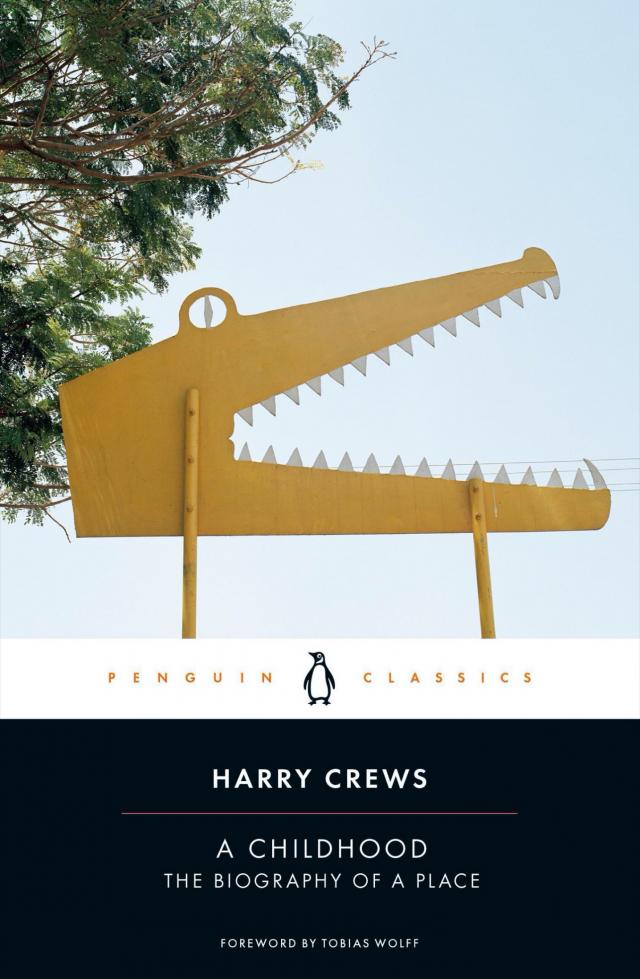
Cover photograph: Jason Fulford
pid_prh_6.0_139403811_c0_r0
This book was written for my boy, Byron Jason Crews
Survival is triumph enough.
—david shelley, in conversation
Contents
Cover
About the Author
Title Page
Copyright
Dedication
Epigraph
Foreword
Part 1
Chapter 1
Chapter 2
Chapter 3
Part 2
Chapter 4
Chapter 5
Chapter 6
Chapter 7
Chapter 8
Chapter 9
Chapter 10
Chapter 11
Chapter 12
Foreword
To enter this book is to enter another world. Though set in an American state—Georgia—in a time not so distant from our own—the first half of the twentieth century—any temptation to feel ourselves on familiar ground is continually revealed as illusion. The way of life Harry Crews describes here, its culture, relation to the land, its employments, trials, pleasures, and dangers—dangers that he himself barely survived—forbids the comfort of recognition. At times, but for the distinctive American music of the voices Crews records, and the occasional mention of a truck or tractor, we might well imagine ourselves in feudal Europe, or the Russia of serfdom. Or, given the eruptions of interfamily violence begetting revenge begetting more violence, Sicily. His past is indeed another country.
A word about those tractors. They figure as a distant rumor—we never see one, any more than we see the owners of the exhausted, unyielding land farmed by Crews’s family and their neighbors. Those who plow these fields do so with the help of mules, if they’re lucky enough to own one. Crews’s father was not so lucky. He had to harness himself to the plow, make a mule of himself from sunup to sundown. Worn out by the labor, he died at thirty-three, leaving his family destitute.
“Wounds or scars,” Crews writes, “give an awesome credibility to a story.” He himself bore enough of these to support any number of stories. And so, it is clear, did the people he grew up with, their lives scarred by poverty and violence. In the absence of effective legal authority, they were left to settle their differences without official mediation or constraint. Indeed, recourse to the sheriff defined a man as a weakling, destined “to be brutalized and savaged endlessly.” Crews witnessed violence in his own home, and felt it like a pulse in the society around him, brought on by causes great and trivial: “As many men have been killed over bird dogs and fence lines in South Georgia as anything else.” His stepfather, in a drunken rage with Crews’s mother, blew the mantel off their fireplace with a shotgun, and the night might well have come to a worse ending. “I knew for certain,” he writes, “that it was not unusual for a man to shoot at his wife.”
Crews does not use the word “poverty” to describe the conditions of his upbringing, perhaps because it is a word generally understood in relation to the prosperity of others—that is, as deprivation. Little as his family had, their community was hardly better off. They did not see themselves as particularly disadvantaged. And in extremity they could draw for a time on the slender resources of extended family or friends. But in truth their lives were a struggle for survival, so desperate at times that “being alive was like being awake in a nightmare.” Their weight went up or down according to the season. The children were subject to rickets, and worms nesting in their throats had to be pulled out by hand to keep them from choking. The family could not afford misfortune, yet misfortune haunted them. When Crews’s mother saw their two precious yearling calves headed toward a barrel of pesticide and ran out to intercept them, Crews, then a toddler, seized that moment of freedom to taste some raw lye his mother had been using to scrub the floor. His cries sent her running back to the house, and from there eight miles by cart to the doctor. When they finally got home again the two calves were dead, lying stiff by the barrel of poison. “The world that circumscribed the people I come from,” Crews writes, “had so little margin for error, for bad luck, that when something went wrong, it almost always brought something else down with it.”
Crews’s family was not alone in their struggle to survive; and just as your misfortune could inspire generosity in friends and neighbors, it could also leave you vulnerable to abuse by other desperate souls. And there was plenty of desperation to go around. On the day Crews’s father was buried, a thief sneaked into their smokehouse and stole the meat the family had stored there, all but one small piece—overlooked, or perhaps a grudging concession to the distant whisper of his conscience. They knew who had done it—the thief was a friend, and not only a friend, but a close friend. After such knowledge, what forgiveness? Yet Crews, understanding all too well the circumstances that could lead to such a damnable act, cannot bring himself to damn the man for it, or even to name him in this book of names, names repeated so lovingly they take on the weight of poetry.
Cecil.
Willalee.
Miss Emily.
Ora.
Alton.
Lottie Mae.
Tweek.
Indeed, the refusal to name the thief can be understood as a punishment as well as a mercy. But it is a mercy. “It was a hard time in that land, and a lot of men did things for which they were ashamed and suffered for the rest of their lives. But they did them because of hunger and sickness and because they could not bear the spectacle of their children dying from lack of a doctor and their wives growing old before they were thirty.”
Hunger, sickness, accidental maiming, unremitting labor for the unreliable reward of another meal, violence, early death. Harry Crews works from a dark palette here, as the truth of his sometimes terrible experience demands, yet the great picture he paints is shot through with light and love, and without even the faintest tincture of bitterness or self-pity. In fact, he is grateful for what he sees as the good fortune of growing up where he did, among the people of that place—a feeling sharpened in him by his forced departure when his mother, in flight from her shotgun-wielding second husband, moved her small family to Florida to take a job in a cigar-rolling factory, and Crews finally encountered modernity. Refrigerators and flush toilets, but the air loud with engine noise, and greasy with exhaust. Houses crowded close together, but inhabited by distant strangers rather than old friends and kinfolk. Paved roads everywhere, but no fields, no mules plowing a furrow “with lovely exactitude.” Dogs roaming the streets, but none herding cattle, or wrestling a sick cow to the ground to receive a dose of medicine.
Crews’s sense of displacement affects us as well, touching us with his own nostalgia for the life he had to leave behind, ugly and hard as it sometimes was. “I come from people,” he writes, “who believe the home place is as vital and necessary as the beating of your own heart. . . . It is your anchor in the world, that place, along with the memory of your kinsmen at the long supper table every night and the knowledge that it would always exist, if nowhere but in memory.”
I give thanks for that memory of his, as I give thanks for the consummate art, and the great heart, that produced this beautiful book, now and forever part of my own memory, where I too have a seat at that long table, drinking in the stories.
tobias wolff
PART 1
CHAPTER 1
My first memory is of a time ten years before I was born, and the memory takes place where I have never been and involves my daddy whom I never knew. It was the middle of the night in the Everglades swamp in 1925, when my daddy woke his best friend Cecil out of a deep sleep in the bunkhouse just south of the floating dredge that was slowly chewing its way across the Florida Peninsula from Miami on the Atlantic to Naples on the Gulf of Mexico, opening a route and piling dirt for the highway that would come to be known as the Tamiami Trail. The night was dark as only a swamp can be dark and they could not see each other there in the bunkhouse. The rhythmic stroke of the dredge’s engine came counterpoint to my daddy’s shaky voice as he told Cecil what was wrong.
When Cecil finally did speak, he said: “I hope it was good, boy. I sho do.”
“What was good?”
“That Indian. You got the clap.”
But daddy had already known. He had thought of little else since it had become almost impossible for him to give water because of the fire that started in his stomach and felt like it burned through raw flesh every time he had to water off. He had thought from sunup to dark of the chickee where he had lain under the palm roof being eaten alive by swarming mosquitoes as he rode the flat-faced Seminole girl, whose name he never knew and who grunted like a sow and smelled like something shot in the woods.
He had not wanted her, but they had been in the swamp for three years. They worked around the clock, and if they weren’t working or sleeping, their time was pretty much spent drinking or fighting or shooting gators. So since he could not have what he wanted, he tried to want what he could have, but it had been miserable, all of it because of the way she sounded and the way she smelled and the mosquitoes clotted about their faces thick as a veil and the heavy black flies that crawled over their legs.
“It weren’t all that good,” daddy said.
“No,” said Cecil, “I don’t reckon it’s ever that good.”
Gonorrhea was a serious hurt in the days before they had penicillin, and the hurt was compounded because daddy had resisted getting any treatment or even telling anybody until the pain finally forced him to do it.
“I don’t know what I’m gone do.”
“I do,” Cecil said. “We gotta get out of the swamp and find you a doctor.”
Cecil felt some obligation to help, not only because they had been friends since childhood but also because it was Cecil who had left Bacon County first to work on the trail and was later able to get his buddy a job working with him. It was all in the best tradition of “If you git work, write.” And when Cecil wrote that there was steady work and good pay to be had in the Everglades, Ray had followed him down there.
He got on one of the gangs cutting right-of-way and in less than two years worked his way into the job of dredge operator. He was then not yet twenty and it was a sweet accomplishment for a boy who had no education, who was away from the farm for the first time in his life. But the clap soured the whole thing considerably.
Cecil was waiting for him when he came out of the doctor’s office in the little town of Arcadia, Florida. It was the third doctor daddy had seen, and this one agreed with the other two. The word was final.
“He says I got to do it.”
“Jesus,” Cecil said.
“It’s no other way.”
“You gone do it?”
“I don’t see no other way. Everyone I seen says I got to have one taken off. I guess I do if it ain’t no other way.”
“Jesus.”
On the long drive back to the swamp in Cecil’s Model T Ford in the shimmering heat of early summer, they didn’t talk. Daddy did say one thing. “I won’t ever have any children if they take it off. That’s what the doctors said. All three of’m said it.”
Cecil didn’t say anything.
* * *
• • •
Did what I have set down here as memory actually happen? Did the two men say what I have recorded, think what I have said they thought? I do not know, nor do I any longer care. My knowledge of my daddy came entirely from the stories I have been told about him, stories told me by my mother, by my brother, who was old enough when he died to remember him first hand, by my other kin people, and by the men and women who knew him while he was alive.
It is demonstrably true that he went to work on the Tamiami Trail when he was seventeen and worked there until he was twenty-three. He did get the clap down there and he did lose a testicle because of it in the little town of Arcadia. He came back to Bacon County with money in his pocket and a gold watch inscribed on the back: “To Ray Crews, Pioneer Builder of the Tamiami Trail.” Cecil got such a watch, as did several of the men who saw the job through from start to finish. Those are facts, but the rest of it came down to me through the mouths of more people than I could name. And I have lived with the stories of him for so long that they are as true as anything that ever actually happened to me. They are true because I think they are true. I, of course, had no alternative. It would have been impossible for me to think otherwise.