Zero day code, p.1
Zero Day Code, page 1
part #1 of End of Days Series


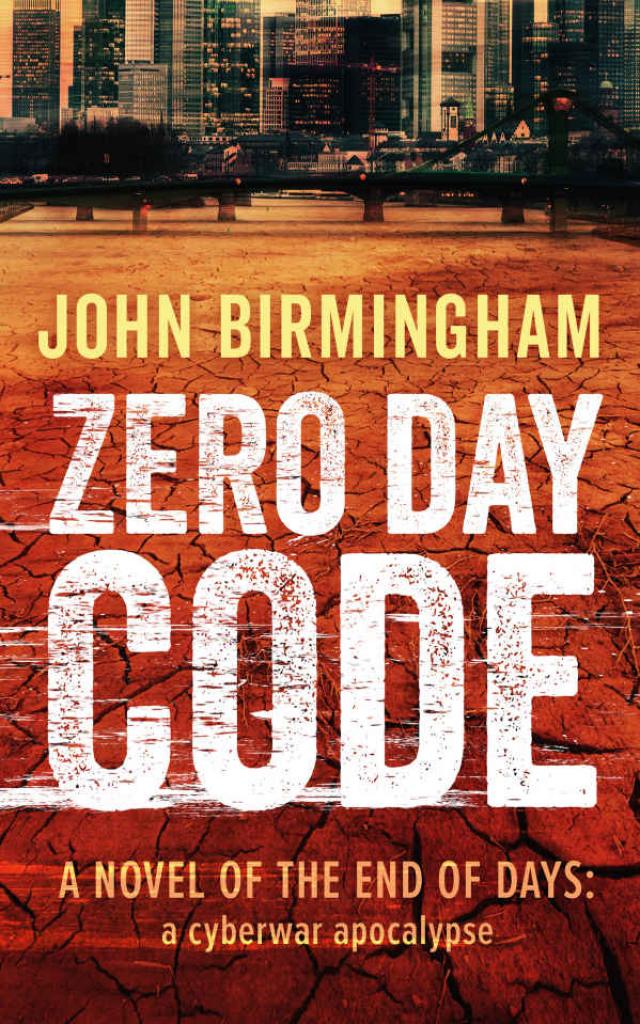
Zero Day Code
A Novel of the End of Days: a cyberwar apocalypse
John Birmingham
Contents
1. A Professionally Careful Guy
2. The Centurion
3. Threat Assessments
4. On my Six
5. Malware Attack
6. Zero Tolerance Policy
Interlude
7. The Oakland Shoot
8. The Junior Mints
9. I’d Rather Be Back In Fallujah
10. System Crash
11. My First Drink In A Year
Interlude
12. You Didn’t Do Nothing Wrong
13. Demonstrable Stupidity
14. You’re Rolling With The Deep State Now
15. The Folly of Wiser Heads
16. This Is Not How It Worked In All Those Tom Clancy Books
17. The Grand Ballet of Steel
Interlude
18. A Carnivore in Silverton
19. The Secrets His Flesh Might Bear
20. Just Like The Crocodile Hunter
21. The Cities Will Starve
22. The Revels of the Condemned
Interlude
23. Four Large By Midnight
24. Power Down In Crazy Town
25. A Killing In The Outer Mission
26. The Plan Jericho Outcomes
27. Reminders of the Fall
28. Defcon 2
29. The City Burns On Water
30. A Legion Approaches
31. American Siege
32. Rally In Silverton
33. Cowboy the Fuck Up
34. Bloodbath
35. Stage Four Collapse
Epilogue
Afterword
1
A Professionally Careful Guy
For James O’Donnell it started at a Texaco on I-95, just a few minutes north of where the interstate takes that big swing east to hook up with the Beltway. James didn’t need to fill up. His Camry hybrid had another two hours of battery power and the tank was full, but so was he. The jumbo latte he’d picked up at Starbucks before leaving Baltimore was sitting heavy in his bladder. The slightly cheaper parking garage where he always pre-booked a spot had no bathroom facilities and it was at least a twenty-minute walk from his appointment.
That’d be a long twenty minutes if he didn’t pull into the gas station and get some relief.
James hissed through his teeth as the little hybrid hit the speed hump standing sentinel over the Texaco’s entryway. He was cutting it close, and he cursed himself for buying the jumbo latte, simply because the cost per fluid ounce was nearly half that of the more modestly sized regular take away. But he was a fool for a bargain. Always had been.
He drove past the pumps and took a bay outside the food court. Big windows gave view into the seating area inside, where patrons sat at moulded plastic furniture with trays of McDonalds, KFC, Dunkin Donuts and the junk food refuse of all the lesser outlets which made up the balance of the concessions. This was not his first visit. He knew from previous trips to the capital that because the food court was a popular, high traffic stop just outside of the Beltway, there were large, unlocked washroom facilities and he wouldn’t need to buy anything to get a key.
Locking the car and taking a messenger satchel with all of his documents, electronics and a cheese sandwich in a Ziplock bag, James walked inside with his suit coat draped over his arm. High summer had passed but the brutal heat of June and July had not backed off at all during August. He started to leak sweat as soon as the steam press humidity fell on him. It was only a short walk to the entrance, but the chilled air that spilled out through the sliding doors felt like a first kiss, long anticipated. His nose wrinkled at the smell of hot grease and fried food, but it was just so pleasantly cool inside, compared to broiling out on the tarmac, that he considered getting a soda and staying a while. He was early, as always.
First though, he hurried through to the washroom and took care of business. There’d be no clear-headed thinking about anything until that was done. After thoroughly washing and drying his hands—the drying is just as important as the washing, you know—he returned to the dining area. For somebody like him, raised on a farm, lunchtime meant noon. That was still half an hour away, but there seemed to be twice as many people lined up at the food counters as there had been when he walked in a few minutes earlier. James checked his watch again.
11.32 AM.
His appointment with Michelle Nguyen was at two, and there would be an unpleasant walk through the heat from the parking garage on 21st to get to her office at the Eisenhower Building. Unpleasant enough that he was open to the idea of booking a cab (but not an Uber) to make the short hop. And he did have time to kill before the meeting. Sitting here and reviewing his notes would definitely be cheaper than doing so inside the Beltway where coffees ran to five bucks a cup if you weren’t careful.
And James O’Donnell? He was a professionally careful guy.
The publisher, editor and only correspondent for The Acorn, a newsletter offering deep market analysis “but absolutely no tips”, took his professional responsibilities very seriously indeed. His subscribers paid him fifty dollars a month for his work—you got one month free with a year’s subscription—and you had to be careful when you were taking that kind of money off people. Most of his subscribers were not wealthy. Not what James would call wealthy, anyway. They were like him: prudent.
He didn’t need to check his phone to know it was hot outside, but he did so anyway.
Jeez! 100.4 degrees.
Okay. He made a prudent decision right then to drop a few dollars on a taxi and to spend half an hour here, reading over his notes for the meeting with Miss Nguyen. It would not do to turn up at the National Security Council dripping with sweat and reeking of BO. He’d been surprised that the researcher had even agreed to meet him in the first place and did not want to mess up the opportunity. Michelle Nguyen was the author of an unclassified paper on the increasing vulnerability of China’s food security to industrial pollution and as bracing as her published conclusions had been, James suspected they’d been significantly watered down for release. Discontinuities in China’s food supply could mean shocks to global supply chains and end markets. It could mean food riots and starvation throughout the developing world, shortages and prices spikes in American supermarkets; threats, but also opportunities.
Ever cautious, he took out his key fob and pressed the button to lock the Camry again. You couldn’t be too careful.
He didn’t want to sit in the main dining area. The smell was gross, but it was also very noisy in there. A large group of children were running wild and their parents were too invested in the enormous McBanquet laid out before them to bother with anything like supervision. Customers argued with counter staff at a couple of the concessions and the music piping through the PA system was loud, tinny and awful. James didn’t much like junk food. He’d been brought up to appreciate a simple but healthy fare on his parents’ farm. There were a few empty tables away from the food court, in the small, separate area where motorists paid for their gas and shopped for the road. The shelves were brightly stocked with cookies, corn chips, pornography and motor oil. It would do.
He resisted the urge to lock the Camry for a third time. Already over-caffeinated, he fetched a small bottle of still water from a large commercial refrigerator which was mostly full of Coke. The water, he knew, was also a product of the Coca Cola Corporation, and the profit margin on it was considerably greater than on any bottle of soda. He resented that, just a little, but it was not fair to expect that Texaco should let him occupy valuable floor space without making something on the deal. The stupidly overpriced water was enough of a sacrifice, by his reckoning, to lease a little time at one of those unoccupied tables.
The line of customers waiting to pay for gas and pornography was long. The two women in Texaco uniforms serving behind the counter were both fussing about with one register. Waiting customers shuffled from one foot to another, checked their phones and grumbled about the delay. The long queue retained its coherent form for another minute, until a stocky man in chinos and a white polo top cursed volubly, abandoned his purchases on top of a Dairy Queen freezer and stomped out. That seemed to be a signal for the small crowd to collapse into a mass around the register, offering comments, technical advice, demands for attention, for a manager, for more staff to appear and operate those registers that were working.
“None of them are working,” snapped the older of the two women. She was a lumpy white matron with grey hair so tightly curled that James had a momentary vision of her sitting under a hair dryer with old fashioned plastic curlers covering her skull. His grandma had done the same thing every day. She’d looked unreal in her casket at the funeral home because the morticians had tried to recreate the effect with a curling wand.
They had failed.
The name tag on the woman’s uniform blouse read MARION and Marion was having as much trouble with the cash register as that funeral home had had with Grandma’s final do. She was punching tentatively at the keypad, frowning at a readout that none of the customers could see. Her co-worker, a much younger woman, Latina in appearance, stood stiffly off to one side, with the sort of terrified rigidity that spoke to her fear that something had gone horribly wrong, and it was all her fault.
Standing at the back of the now collapsed queue, James realised the small dramas he’d witnessed out in the food court and dismissed as the banal filler scenes of modern life—som
He considered returning the bottle of water but found that he really wanted it now. His mouth was dry. He fetched out his wallet and removed a dollar note, the cost of the spring water. The old leather billfold, a gift from his parents when he had gone away to college, contained three hundred dollars exactly. Four fifties, four twenties, and the balance in tens and ones. When he travelled for business, as he was today, he always carried the same amount in cash. Not enough that losing it or being robbed would be a disaster, but enough to know that he could be confident of buying transport or shelter if the need arose. He’d once been stuck in Akron with a frozen credit card and no other liquidity.
Never again.
Now he always carried cash and his Mastercard was linked to a debit account. He never used the card directly if he could avoid it, preferring to make any transactions via Apple Pay, trusting the security of the tech giant’s one-use token to protect him from scammers and skimmers.
There would be no using it today, however. Things were getting out of hand at Texaco. A man was screaming at the McDonald’s counter that he had paid for his chocolate sundae and by god he was getting his chocolate sundae. Those unsupervised children were now running and jumping from tabletop to tabletop, taking maximum advantage of all of the grown-ups being distracted.
Waving the dollar note for his water at the Latina girl behind the counter, James paid and walked the short distance back to the main food court. His success occasioned a small riot as the other customers suddenly remembered that paying by cash was still legal. People in the food court were now shouting at each other so loudly, some of them yelling that they’d been robbed, that it became obvious to James that he wasn’t going to get any work done. Before stepping outside into the killing heat, he did take a moment to check out the motorists filling their cars at the dozens of gas pumps. They seemed oblivious to the chaos inside in the roadhouse. The pumps seemed to be working without a problem. Traffic still flowed along I-95.
Just a glitch in the payment system, then?
He made a note on his phone to look into it when he was done with this interview. If the problem had recurred in the previous twelve months, he would have to block out some time when he got home this evening to do a deep dive into Texaco’s payment processing architecture. FinTech was a sector that existed in a state of near permanent disruption these days. It was the sort of thing his subscribers paid him to get ahead of. If needs be, he would sit up through the night in his modest two-bedroom apartment, writing a supplemental mail out for this week.
As it turned out, though, that wouldn’t be necessary.
James O’Donnell never set foot in his apartment again.
2
The Centurion
The weirdest two days of Jonas Murdoch’s life started, as always, before dawn. One difference, though? He woke to discover he was famous. Or internet famous, at least.
Okay. Fuck you. Subreddit famous. But he’d take it.
Jonas lived in a small, dark brick house in the grey suburban wastelands half an hour south of SeaTac. Thorny weeds choked everything out of the garden, and grimy, unwashed windows rattled in splintered wooden frames when the big jets came in low from the south. He shared the rundown bungalow with Mikey Summers, a roommate he saw rarely and about whom he could give less than one grudging fuck. The dude helped pay the bills and that was about the best you could say of him. Jonas paid his own share of the rent with the bullshit wage he made hauling crap around an Amazon warehouse down in Sumner, another five minutes south on Route 5.
The warehouse, or ‘fulfilment centre’ in the bizoid doublespeak of the company, was a huge facility, sprawling over half a million square feet to the west of the rail line. Working there was about a thousand fucking miles from fulfilling, but Jonas woke before dawn every morning knowing that he badly needed the job, at least for now. That was a sour fucking feeling, but it didn’t make him special, did it?
No. What made Jonas Murdoch special was The Centurion.
Three days a week, he got up in the dark to hit a local CrossFit box – or, to be honest, a cheap copy of one, because who had two hundred bucks a month for the real thing, right? But four days a week he rose before the first ray of light to prepare and record The Centurion.
He’d started the podcast in desperation, after lighting out of Florida where his pissed off ex-wife, Trisha, had sued for alimony he couldn’t pay, and she’d retained as her lawyer—get this— his pissed off ex-boss, Hondo Alvarez.
That greasy bastard was probably doing the bitch too, because Hondo loved nothing so much as to fuck with Jonas Murdoch’s life. It had been like this the two years he’d worked for him in Florida, running all of Hondo’s shittiest errands, repping for his worst clients. Always on a promise of something better coming just around the corner.
Jonas stopped in the middle of the small, crowded living area. He was a big man, jailhouse strong, and he took up a lot of space. There was crap all over the floor and he was holding a cup of ice water to get his metabolism going. His way through the dark was poorly illuminated by the tiny red lights of sleeping electrical equipment and the ghostly glow of Mikey’s stupid aquarium. Those fish and a hard-on for cycling hundreds of miles a week were what his roomie had instead of a life.
Standing there in the dark, surrounded by piles of Mikey’s junk food refuse, it was only natural that Jonas would start thinking about Hondo.
The guano-eating tool was the reason he was stuck out here on the wet edge of nowhere, selling Centurion tee-shirts to dumbass Nazis to pay for his protein shakes.
But there was no point stewing on that. He needed to focus. If Jonas let himself pick at every scab and half-healed wound he had from Miami, he’d bleed out here on the floor of this depressing little hovel — long before Mikey Summers showed his ugly freckled face and started shovelling big handfuls of Cap’n Crunch into it for breakfast.
No fucking way did Jonas want to hang around for that.
He drank the ice water fast, to clear his head, with a cold spike of pain if necessary. Hondo could suck him hard. Jonas would dial in on his own shit. He would focus like a motherfucker. Fuck yeah that’s what he would do.
He’d been reading up on the way the modern world conspired against focus. He’d heard a podcast with some physicist or computer science guy or something fapping on about deep work and shallow shit and digital distraction. And yeah, it was mostly bullshit and the guy was obviously a cuck with a side hustle in self-help and personal empowerment for lesser cucks, but Jonas did take away one thing from the ten minutes he could bear listening to.
Phones, social media and the internet had fucked everyone up.
People with true focus were becoming increasingly rare. And what was rare was valuable.
In spite of all the shit he’d gone through with his wife, his boss, the fucking Florida bar and the conga line of suppurating assholes he’d formerly known as clients, Jonas Murdoch prided himself on being a guy who could still focus.
And his focus was one hundred percent on building The Centurion until he was as big as Alex Jones or Mike Cernovich — without flaming out like Jones of course. The crazy asshole.
Jonas had zero doubts that he would get there. Doubts were what losers had instead of focus. He centred himself, let go of the rage which always burned just under the surface of things, and carefully picked his way through all the shit on the floor, heading towards the desktop computer where he recorded the podcast.