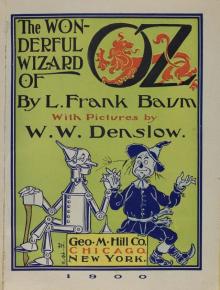
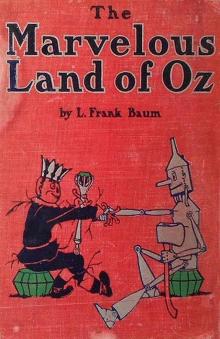
A wonderful welcome to o.., p.1
A Wonderful Welcome to Oz, page 1
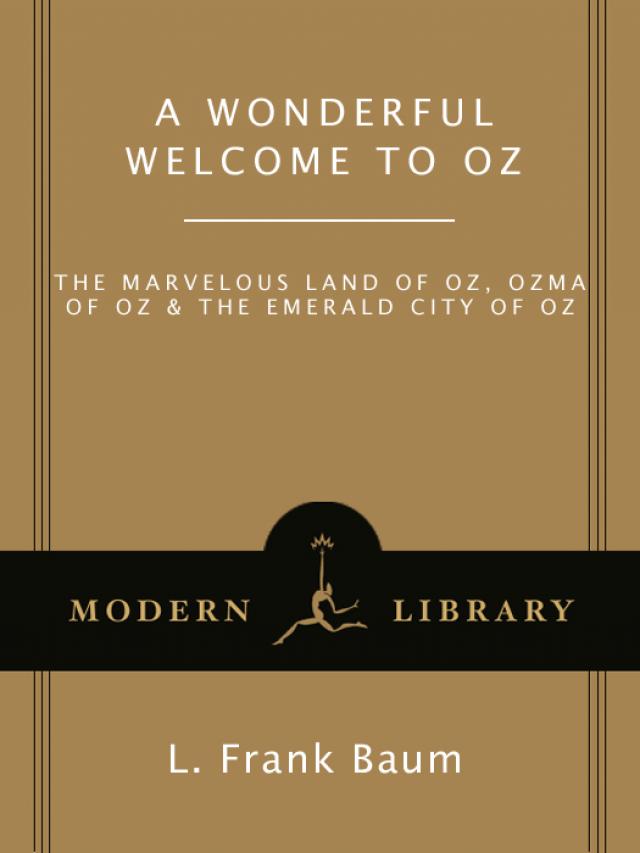


2006 Modern Library Paperback Edition
Introduction, “Traveling On?” and “Let’s Talk About Oz” copyright © 2006 by Gregory Maguire
Biographical note copyright © 2003 by Random House, Inc.
All rights reserved.
Published in the United States by Modern Library, an imprint of The Random House Publishing Group, a division of Random House, Inc., New York.
MODERN LIBRARY and the TORCHBEARER Design are registered trademarks of Random House, Inc.
LIBRARY OF CONGRESS CATALOGING-IN-PUBLICATION DATA
Baum, L. Frank (Lyman Frank), 1856–1919.
A wonderful welcome to Oz / L. Frank Baum; selected and with an introduction by Gregory Maguire; illustrations by John R. Neill.
p. cm.—(Modern Library classics)
Summary: A collection of three adventures in Oz, including the sequel to The wizard of Oz, Dorothy’s return to Emerald City under its new ruler, and Aunt Em and Uncle Henry’s visit there with Dorothy.
Contents: The marvelous land of Oz—Ozma of Oz—The Emerald City of Oz.
eISBN: 978-0-307-79688-2
[1. Fantasy.] I. Maguire, Gregory. II. Neill, John R. (John Rea), ill. III. Title. IV. Series.
PZ7.B327Wol 2005
[Fic]—dc22 2005054038
www.modernlibrary.com
v3.1_r1
L. FRANK BAUM
Lyman Frank Baum, otherwise known as L. Frank Baum, one of the world’s most celebrated children’s authors, was born to Cynthia Stanton and Benjamin Ward Baum on May 15, 1856, in Chittenango, New York. His affluent parents arranged private tutoring for the delicate young Baum, who had been afflicted with a heart condition that shortened his brief schooling at the Peekskill Military Academy in 1870. As a teenager, Baum wrote and printed a house newspaper, The Rose Lawn Home Journal. He seemed to have found his professional calling early in life, and other journals of his creation followed. In 1874, however, he joined a theater company and became an actor.
That Baum had two vocational passions was apparent, although his career path remained unclear for years; he found a measure of success with both newspaper reporting and acting. He joined the Union Square Theatre of New York City in 1878, and in 1882 he organized his own company, wrote a dramatic script, and played the lead in the acclaimed The Maid of Arran. That year Baum also married Maud Gage. With the birth of their first son, Frank Joslyn, in 1883, financial stability became increasingly important. Poor accounting caused Baum to lose a chain of theaters given to him by his father, forcing him to join the family business selling Baum’s Castorine, a grease made from crude oil.
Baum’s first foray into book publishing was a curiosity. The Book of the Hamburgs, his nonfiction book about breeding Hamburg chickens, was published in 1886. A second son, Robert, was born that year. The family fortunes declined after the death of Baum’s father in 1887, and in yet another career change, Baum moved to a small prairie town in the Dakotas, where he ran a general store called Baum’s Bazaar for two years. In 1889, a third son, Harry, was born, and soon Baum returned to writing and newspaper publishing. He operated The Aberdeen Saturday Pioneer, where he penned a popular column titled “Our Landlady,” until the paper failed. In 1891, a fourth son, Kenneth, arrived, and the Baums relocated to Chicago, where Baum landed a reporting job with The Evening Post. He also held, over the next few years, secondary jobs as a traveling salesman. Indeed, he was ever occupied—even as his first children’s book, Mother Goose in Prose, was published in 1897, he concurrently founded Show Window, a journal dedicated to store window-dressing. He also wrote and self-published a volume of poetry, By the Candelabra’s Glare.
The success of Baum’s second book of children’s verse, Father Goose, published in 1899, demonstrated that he could be a best-selling writer. Beautifully illustrated by Baum’s longtime collaborator, William Wallace Denslow, Father Goose was a prelude to Baum’s masterwork. In 1900, The Wonderful Wizard of Oz found substantial popularity among readers, and critics too valued Baum’s vibrant characterization. Full of hope and optimism, Baum had created the first American fairy tale. That pivotal and productive year also saw the publication of The Army Alphabet, The Navy Alphabet, and A New Wonderland for Children, as well as a collection of his Show Window articles, The Art of Decorating Dry Good Windows and Interiors.
More children’s books followed, including American Fairy Tales and The Master Key, but none achieved the celebrity of the Oz book, which gained even more fame as a stage adaptation in 1902. Although Baum endeavored to widen his literary efforts (he never meant to publish a series), the intense demand for fiction about the magical land of Oz was overpowering. In 1904, he published a sequel, The Marvelous Land of Oz (later known as The Land of Oz). Baum also completed other works of juvenile fiction during this time, notably The Woggle-Bug Book and Queen Zixi of Ix. His romantic adventure novel for adults, The Fate of a Crown, was one of the many books he wrote under a pseudonym.
In 1907, he returned again to Oz with Ozma of Oz. Dorothy and the Wizard of Oz appeared one year later, followed by The Road to Oz in 1909, and in 1910 he published what he intended to be the last in the series, The Emerald City of Oz. The Baums moved to a house they named Ozcot in California. Investments in failed adaptations of his stories, however, forced the prominent writer to declare bankruptcy in 1911, also the year of publication for The Sea Fairies. Sky Island followed in 1912. Financial pressures and appeals from readers for new Oz stories motivated Baum to write The Patchwork Girl of Oz, published in 1913. His play The Tik-Tok Man of Oz enjoyed a favorable run in Los Angeles that year and was adapted to book form as Tik-Tok of Oz in 1914. Between 1915 and 1919, Baum wrote one Oz book per year, of varying literary quality—The Scarecrow of Oz, Rinkitink in Oz, The Lost Princess of Oz, The Tin Woodman of Oz, and The Magic of Oz.
Though Baum remained a highly productive writer, his health waned. On May 6, 1919, he succumbed to his longtime ailments. The last in the Oz series to have been written by its creator, Glinda of Oz, was published in 1920. Baum’s publishers then hired another writer to sustain the popular series for future generations of readers. The 1939 film version of Baum’s original Oz novel showcased his incomparable imaginative power for a wider audience and ensured the beloved classic’s place in American mythology.
SOURCES
Rahn, Suzanne. The Wizard of Oz: Shaping An Imaginary World. New York: Twayne Publishers, 1998.
Riley, Michael O. Oz and Beyond: The Fantasy World of L. Frank Baum. Lawrence, Kan.: University Press of Kansas, 1997.
Rogers, Katharine M. L. Frank Baum, Creator of Oz. New York: St. Martin’s Press, 2002.
Twentieth Century Literary Criticism, volume 7. Farmington Hills, Mich.: Gale, pp. 11–12.
CONTENTS
Cover
Title Page
Copyright
BIOGRAPHICAL NOTE
INTRODUCTION: WELCOME TO OZ by Gregory Maguire
THE MARVELOUS LAND OF OZ
OZMA OF OZ
THE EMERALD CITY OF OZ
A HIGHLY CONDENSED HISTORY OF OZ
TRAVELING ON? SUGGESTED FURTHER READING
LET’S TALK ABOUT OZ: A READER’S GUIDE
INTRODUCTION
WELCOME TO OZ
Gregory Maguire
If you say, “I was a bookish kid,” then, for the bio-flick of your life, the director relies on Central Casting to locate a slope-shouldered boy with long lashes and a weak chest, sporting horn-rimmed eyeglasses four sizes too large for him. Or a girl with a dewy vastness in her expression, and a satin sash, and preternaturally clean fingernails. Or someone to whom both those descriptions apply, gender at that age being largely irrelevant.
I was a bookish kid, and no slave to Charles Atlas—and I did wear glasses. And do. But my nails were dirty, my T-shirts scuzzy, my fingers stained with watercolors, my curly hair buzz-cut into submission and further flattened because I taught myself to carry my library books home on my head like an Ashanti woman coming home from the village well.
It’s an accurate metaphor, if far-fetched. To a ten-year-old reader, dismally stuck in the baking heat of the city for most of the summer, the public library was a village well. And what I brought home on my head nourished me like water.
By then, I was aware of the dozens of worlds not only beyond the neighborhood of Pine Hills in Albany, New York, but beyond the navigable margins of the horizon. I made weekly visits to Neverland, Wonderland, Prydain, Narnia, and the 100 Aker Wood; to the mansion of Malplaquet and the manor house at Green Knowe; to 17 Cherry Tree Lane in London, where Mary Poppins came and went; and to the Victorian villa at 40 Walden Street, Concord, where the Hall children had their magical adventures in Jane Langton’s books.
Later I would discover the Inferno, Middle-earth, Atlantis, Camelot, Attic Greece, Prospero’s island, Gormenghast’s castle, and Dickens’s London. And later still I would return—like an expat making a sentimental journey home—to the wells of the library to learn about places newly discovered since my prepubescent years: Hogwarts, Earthsea, Joan Aiken’s alternate England, and the thousand thousand lands implicit in Philip Pullman’s magnificent cycle. Pullman proposes that all possible histories—those with magic and those without—lie adjacent to one another, or even nestled within each other. His is a Unified Field Theory of otherworlds: There isn’t one, but an infinite number.
In one of those infinite worlds lived I, saddled with lovingly tyrannical parents who endorsed reading and who only rarely let us watch
It seemed we inhabited incompatible, mutually exclusive zones. Yet no matter how many times Dorothy left Oz at the end of the first book, I had only to open to the front again to bring her magically back, riding that twister sidesaddle. And to bring myself back, too.
The bookish kid grows up to learn all sorts of things that children’s books don’t generally reveal. Being able to satisfy one’s wanderlust for the world at hand, however, doesn’t quell the appetite for the strictly literary sojourn.
With my U.S. passport, I traveled as far as the laws of this globe—and my finances and courage—allowed me. With my library card, I also returned to the haunts of my youth—the literary fantasies of childhood—to be nourished, or occasionally disappointed when my destinations seemed smaller, shabbier, less wonderful than I had remembered. More as an act of nostalgia than anything else, I began to order and compare the magic lands I loved.
The nineteenth century was a golden era of literary fantasy. Not the first, mind you, but the first for an educated middle-class audience. Literary fantasy in its nascent forms promoted nationalistic self-identification, and served also as a corrective to the ills of filthy early industrialism. The Romantic era of Wordsworth and Keats and Shelley in England, and, in a sense, of Washington Irving and Poe in the new world, had primed readers to appreciate the magic of the domestic märchen collected by the Brothers Grimm in Bavaria and published in English in 1823. Shortly thereafter, building on a seventeenth- and eighteenth-century tradition of original droll fables circulated in ladies’ salons, Hans Christian Andersen popularized the obscure subgenre of the “literary” fairy tale—the fanciful story invented out of whole cloth, intended to evoke magical tales of antiquity and barnyard common sense alike: Ovid and Aesop, the ballad and the New Testament parable. Could there have been a Lewis Carroll or a Charles Kingsley in the mid-1860s without a Hans Christian Andersen in the 1840s, or an L. Frank Baum by the turn of the century without a Lewis Carroll before him?
Certainly Alice’s Adventures in Wonderland, published in 1865, counts obliquely as a literary progenitor of Dorothy in Oz. Both in the United States and in England, Alice’s Adventures in Wonderland and Through the Looking-Glass were two of the bestselling children’s books of the century. It would not have escaped L. Frank Baum, who was unabashedly interested in commercial success, that the story of a fanciful voyage to a land of nonsensical wonder had made its author buckets of money.
But despite the obvious narrative similarities—plucky girl slips accidentally into magical landscape, returns—the story of Oz was invented by a different artist, in a different country, for a different purpose. Wonderland is a dreamworld; its inconsistency and absurdity are signal characteristics of the hypnagogic state. Oz—especially as depicted in Baum’s first and best Oz novel—is a land of comic incongruity, a pell-mell stitching together of fanciful set pieces that nonetheless adheres to principles of cause and effect. Practicality and common sense are just as strong as magic. The homely virtues of self-reliance and good cheer—as well as courage, smarts, and a kindly heart—are the main supplies one needs to face down humbug wizards, wicked witches, and pomposity and small-mindedness of all sorts.
(Incidentally, J. M. Barrie conceived of making a play out of his Peter Pan notions as early as 1901, after seeing a London stage production of Bluebell in Fairyland. By 1901, the surprising success of The Wonderful Wizard of Oz in the United States might well have come to his attention. Neverland would be made out of scraps of a child’s imagination—the pirates and Redskins and mermaids, the flying and the fairies, and the fate of being brilliantly, happily, temporarily orphaned—all heartfelt desires of safe middle-class children. I’ve never heard it said that Neverland owed anything to Oz, and I don’t think it does. But how interesting that so much mapping of dreamscapes was going on nearly simultaneously, when the twentieth century would all but blast the notion of the innocent childhood to smithereens.)
The history of the surprising success of The Wonderful Wizard of Oz can be found elsewhere. It is a book that I loved and puzzled over, and one that I happily plundered for raw material when writing my own novels for adults, Wicked and Son of a Witch.
Mostly by its annual airing on television between the late 1950s and 1980, the famous 1939 MGM film The Wizard of Oz secured in the public mind a pared-down (and in some ways more coherent) version of Baum’s original lolloping tale. It worked its Technicolor magic on me, for sure, as it was one of the few films aired on TV that I was permitted to watch. But for many young viewers in the 1960s and 1970s, the film effectively eclipsed rather than enhanced the reputation of the Oz franchise—fourteen books by Baum himself and, at this writing, some thirty-five more or less authorized additions to the series. And that’s not even mentioning the heretical revisionists like Geoff Ryman, Philip José Farmer, myself, and others. (Chapter two of Edward Eager’s children’s novel Seven-Day Magic is worth seeking out.)
This volume exists to help redress that balance. In the first decades of the twentieth century, thousands of American children waited for their annual holiday gift of the latest Oz volume. They knew there was more to Oz than Dorothy’s classic shipwreck-by-cyclone. While Baum was not overly concerned with the history of Oz—the lapses and contradictions prove his attention strayed from time to time—he was tirelessly inventive as regards the spectacle, the curious and the novel, the quaintly bizarre. The books are uneven in quality, and none of them is as tightly plotted as the original or the sequel. But once readers discovered Oz, they seemed content to enjoy the largely picaresque nature of the later books. New characters continued to amuse, and if in time the original characters, reappearing, seemed stodgy, worn about the edges, and more sentimentally inclined, no one minded.
There is this truth. Anyone who travels is torn between the sexy and dangerous temptation of the unknown on the one hand and, on the other, the comfort and solace of the familiar.
The current volume collects three of Baum’s additional Oz novels and includes a brief extract from a fourth.
The Marvelous Land of Oz (sometimes called The Land of Oz) was written following the success of the first stage version of The Wonderful Wizard of Oz. The 1904 novel is generally lighter in tone, a bit more vaudeville, than the sober Wizard, which for all of its detractors (and there have been quite a few) had the virtue of being written in American plain-style, with few flourishes or cloying “heartfelt” moments. Baum was a competent writer, but in Wizard he had a better idea than he deserved, and he was possessed of enough good sense to write simply and to let the story speak for itself.
The Marvelous Land of Oz is written by a more confident hand, and the occasional glimpse of dreaded “facility” begins to show. In the first sequel, Dorothy has not yet made her reappearance. The Scarecrow and the Tin Woodman are the familiar characters, and Baum used them partly because in the 1902 stage version of Wizard, two magnificent vaudeville performers, Fred Stone and David C. Montgomery, had brought those characters to new life. (I know how Baum felt, having seen the same thing happen while watching the stage musical based on Wicked.)
In Land, the orphan boy Tip helps put down a revolution in the Emerald City, and the royal Ozma is recovered from her hiding place. While Ozma seems more gutsy when still in her disguise, she matures into the closest thing to a goddess that the unrepentantly secularist Baum ever devised. More on this below.
Ozma of Oz followed in 1907. The volume deserves attention for the solidification of Ozma as a kind of youthful materfamilias—part Lady Liberty, part Gibson Girl—and for the introduction of new characters possessed of grit and gumption. Baum had not yet sold out to the notion of Oz as an all-purpose “fairyland,” a literary theme park. (That temptation was strong, and Baum couldn’t always resist it. The further along the series went, the more prone was he to depicting Oz as a sunny Utopia, a kind of Big Rock Candy Mountain where little went wrong. Narrative crackle occasionally became a bit muted.)