The complete psychotechn.., p.1
The Complete Psychotechnic League, Vol. 2, page 1
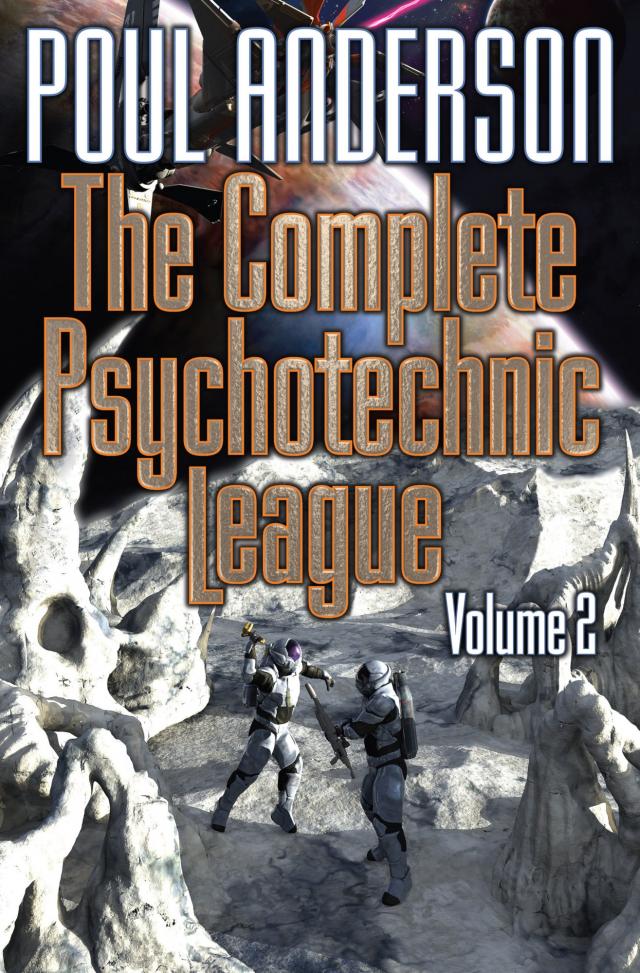


Table of Contents
Forward
Quixote and the Windmill
Holmgang
Cold Victory
What Shall It Profit?
The Troublemakers
The Snows of Ganymede
Brake
Gypsy
Star Ship
The Complete Psychotechnic League: Volume 2
by Poul Anderson
FROM THE RAVAGES OF WAR, HOPE FOR A BRIGHTER TOMORROW
After World War III has ravaged the globe and toppled once-great nations, a new science offers hope for the future: Psychodynamics, the ability to influence government and popular opinion. Led by the Psychotechnic Institute, humanity denounces its violent ways, once and for all. Peace reigns on Earth. Humankind shakes off the tyranny of gravity and ventures out into the galaxy. But no sooner is utopia realized than the cycle of war and destruction begins anew.
The second of three volumes collecting all of multiple Hugo- and Nebula-Award winning author Poul Anderson's massive future history magnum opus. Includes short stories previously uncollected in a Psychotechnic League volume!
Baen Books
by Poul Anderson
The Technic Civilization Saga
The Van Rijn Method
David Falkayn: Star Trader
Rise of the Terran Empire
Young Flandry
Captain Flandry: Defender of the Terran Empire
Sir Dominic Flandry: The Last Knight of Terra
Flandry’s Legacy
The Psychotechnic League
The Complete Psychotechnic League, Volume 1
The Complete Psychotechnic League, Volume 2
The Complete Psychotechnic League, Volume 3 (forthcoming)
The High Crusade
To Outlive Eternity and Other Stories
Time Patrol
The Complete Psychotechnic League: Volume 2
This is a work of fiction. All the characters and events portrayed in this book are fictional, and any resemblance to real people or incidents is purely coincidental.
Copyright © 1981 by Poul Anderson
All rights reserved, including the right to reproduce this book or portions thereof in any form.
Forward copyright © 1982 by Sandra Miesel. Reprinted by permission of the author.
“Quixote and the Windmill” originally appeared in Astounding, 1950. Reprinted by permission of the Poul Anderson estate.
“Holmgang” originally appeared as “Out of the Iron Womb” in Planet Stories, 1957. Reprinted by permission of the Poul Anderson estate.
“Cold Victory” originally appeared in Venture Science Fiction, 1957. Reprinted by permission of the Poul Anderson estate.
“What Shall It Profit” originally appeared in Galaxy, 1955. Reprinted by permission of the Poul Anderson estate.
“The Troublemakers” originally appeared in Cosmos Science Fiction and Fantasy, September 1953. Reprinted by permission of the Poul Anderson estate.
“The Snows of Ganymede” originally appeared in Startling Stories, Winter 1955. Reprinted by permission of the Poul Anderson estate.
“Brake” originally appeared in Astounding, 1957. Reprinted by permission of the Poul Anderson estate.
“Gypsy” originally appeared in Astounding, 1950. Reprinted by permission of the Poul Anderson estate.
“Star Ship” originally appeared in Planet Stories, 1950. Reprinted by permission of the Poul Anderson estate.
Baen Publishing Enterprises
P.O. Box 1403
Riverdale, NY 10471
www.baen.com
ISBN: 978-1-4814-8306-3
eISBN: 978-1-62579-628-8
Cover art by Kurt Miller
First Baen printing, February 2018
Distributed by Simon & Schuster
1230 Avenue of the Americas
New York, NY 10020
Printed in the United States of America
10 9 8 7 6 5 4 3 2 1
Electronic Version by Baen Books
www.baen.com
Forward
by Sandra Miesel
The critical decades following World War III were years of chaos and stubborn courage. Looking back across the millennia at the colossal challenge our twentieth-century ancestors faced, we must salute the sacrifices they made to restore their shattered world. While mourning the follies of violent ages gone by, we humans can take pride in this: after each disaster, our species keeps on striving, like a trampled plant once more struggling towards the sun.
Of course in this case as in all cases timing as well as determination influenced the outcome of events. If World War III had erupted much later than 1958, perhaps no amount of heroism could have saved civilization from extinction. As it was, the East-West exchange of “nuclear Christmas presents” left key areas of both sides in radioactive ashes. Local wars followed global war; plagues succeeded famine. Civilization spun down toward darkness.
The first spark of hope kindled in Europe when Valti’s theories of sociosymbolic logic proved themselves in practice. We who take psychodynamics as much for granted as hyperlight physics may find it difficult to appreciate what those first crude equations meant. No longer would we stumble through each day as it came; the future could be adjusted to fit the common good. To insure this happy outcome, the Psychotechnic Institute was founded. It became the self-appointed torchbearer for our race.
The United Nations, revived by the First Conference of Rio in 1965, was an effective instrument for putting the Institute’s discoveries into action. This intimate and largely fruitful collaboration continued for more than a century. Together the Institute and the world organization presided over the rehabilitation of Earth.
Their first task was to preserve the hard-won peace. Our initial volume, The Psychotechnic League, recounts four significant episodes in the process. Guided by the new social science, men with “dirty hands and clean weapons” destroyed potential dictators before irreparable harm was done. Sacrificing the few today on behalf of the many tomorrow was the ethic that shaped an era.
With the return of peace came plenty. Once people could safely grow food and produce goods again, output surpassed all expectation. Automated equipment compensated for population loss. Pent up demand following decades of want sent the postwar economy soaring. The need for alternative energy sources to replace those ruined by the war was met by solar power and synthetic fuels with superdielectrics for storage. Once power-beaming satellites went into orbit, Earth’s energy worries seemed over.
Earth grew green again. There was a keen, well-nigh universal desire to preserve whatever beauty the war had spared and restore what it had ravished. Acute ecological awareness would soon inspire foundation of the Pancosmic religion, a faith that continues to attract many adherents, human and nonhuman alike.
Zeal for reclamation plus the practical experience gained from building undersea settlements prepared Earthlings to colonize the Solar System. Soon domed cities rose on Luna, the asteroids, and even distant Ganymede. Bold terraforming schemes made Venus and Mars habitable after nearly a century of heartbreaking toil. The independent Order of Planetary Engineers (originally the UN’s Planetary Engineering Corps) distinguished itself in all these projects but the “enterprise beyond the sky” was truly a species-wide concern. Mere survival did not suffice: Mankind was out to leave its mark on the universe.
But the Psychotechnic Institute foresaw that this burst of energy would fade. Remolding worlds was simpler than remodeling humanity. While continuing to chart and influence the behavior of whole societies, the Institute also experimented with individuals. For a time, an elaborate holistic conditioning system known as Tighe Synthesis seemed an excellent way to maximize human potential. Although a few receptive subjects benefited from the training, this promising discovery was never widely applied. Not only was it impractical to condition the entire population adequately, the process put too much power in the hands of the conditioners.
Yet despite its shortcomings, the science of psychodynamics was our margin of survival. Institute-trained personnel were indispensable in that first critical century following World War II. Foremost among these heroes were the UN-Men cloned from a maquis named Stefan Rostomily. (Humble, gifted, and steadfast, the Rostomily Brotherhood was destined to outlast the Institute that had created it.) United Nations agents were everywhere in those days but perhaps their most admirable feat—one which redounded to the Institute’s credit—was the liberation of Venus from a bleak Stalinist tyranny in 2065. With the collective state gone, the colonists speedily developed a fiercely parochial clan-based society whose romantic folkways were celebrated in popular entertainment for generations afterwards. Political historians still analyze Venus as an experiment in local autonomy.
By the opening of the twenty-second century, the Psychotechnic Institute’s power and prestige reached their zenith. The bright future it had planned for humanity seemed inevitable. High technology was triumphant. The blessings of the Second Industrial Revolution were available to all. No one went hungry or homeless anymore. Work had become a privilege instead of an obligation. From sophisticated Earthlings to roughneck colonial, mankind shared a common, semantically rigorous language called Basic. The space navy of the newly formed Solar Union stood guard from Venus to the Belt. The New Enlightenment bathed Sol’s children in the cool radiance of reason.
But there were shadows . . .
Quixot
THE FIRST ROBOT in the world came walking over green hills with sunlight aflash off his polished metal hide. He walked with a rippling grace that was almost feline, and his tread fell noiselessly—but you could feel the ground vibrate ever so faintly under the impact of that terrific mass, and the air held a subliminal quiver from the great engine that pulsed within him.
Him. You could not think of the robot as neuter. He had the brutal maleness of a naval rifle or a blast furnace. All the smooth silent elegance of perfect design and construction did not hide the weight and strength of a two and a half-meter height. His eyes glowed, as if with inner fires of smoldering atoms; they could see in any frequency range he selected, he could turn an X-ray beam on you and look you through and through with those terrible eyes. They had built him humanoid, but had had the good taste not to give him a face; there were the eyes, with their sockets for extra lenses when he needed microscopic or telescopic vision, and there were a few other small sensory and vocal orifices, but otherwise his head was a mask of shining metal. Humanoid, but not human—man’s creation, but more than man—the first independent, volitional, nonspecialized machine—but they had dreamed of him, long ago, he had once been the jinni in the bottle or the Golem, Bacon’s brazen head of Frankenstein’s monster, the man-transcending creature who could serve or destroy with equal contemptuous ease.
He walked under a bright summer sky, over sunlit fields and through little groves that danced and whispered in the wind. The houses of men were scattered here and there, the houses which practically took care of themselves; over beyond the horizon was one of the giant, almost automatic food factories; a few self-piloting carplanes went quietly overhead. Humans were in sight, sun-browned men and their women and children going about their various errands with loose bright garments floating in the breeze. A few seemed to be at work, there was a colorist experimenting with a new chromatic harmony, a composer sitting on his verandah striking notes out of an omniplayer, a group of engineers in a transparent-walled laboratory testing some mechanisms. But with the standard work period what it was these days, most were engaged in recreation. A picnic, a dance under trees, a concert, a pair of lovers, a group of children in one of the immemorially ancient games of their age-group, an old man happily enhammocked with a book and a bottle of beer—the human race was taking it easy.
They saw the robot go by, and often a silence fell as his tremendous shadow slipped past. His electronic detectors sensed the eddying pulses that meant nervousness, a faint unease—oh, they trusted the cybernetics men, they didn’t look for a devouring monster, but they wondered. They felt man’s old unsureness of the alien and unknown, deep in their minds they wondered what the robot was about and what his new and invincible race might mean to Earth’s dwellers—then, perhaps, as his gleaming height receded over the hills, they laughed and forgot him.
The robot went on.
There were not many customers in the Casanova at this hour. After sunset the tavern would fill up and the autodispensers would be kept busy, for it had a good live-talent show and television was becoming unfashionable. But at the moment only those who enjoyed a mid-afternoon glass, together with some serious drinkers were present.
The building stood alone on a high wooded ridge, surrounded by its gardens and a good-sized parking lot. Its colonnaded exterior was long and low and gracious; inside it was cool and dim and fairly quiet; and the general air of decorum, due entirely to lack of patronage, would probably last till evening. The manager had gone off on his own business and the girls didn’t find it worthwhile to be around till later, so the Casanova was wholly in the charge of its machines.
Two men were giving their autodispenser a good workout. It could hardly deliver one drink before a coin was given it for another. The smaller man was drinking whiskey and soda, the larger one stuck to the most potent available ale, and both were already thoroughly soused.
They sat in a corner booth from which they could look out the open door, but their attention was directed to the drinks. It was one of those curious barroom acquaintances which spring up between utterly diverse types. They would hardly remember each other the next day. But currently they were exchanging their troubles.
The little dark-haired fellow, Roger Brady, finished his drink and dialed for another. “Beatcha!” he said triumphantly.
“Gimme time,” said the big redhead, Pete Borklin. “This stuff goes down slower.”
Brady got out a cigarette. His fingers shook as he brought it to his mouth and puffed it into lighting. “Why can’t that drink come right away?” he mumbled. “I resent a ten-second delay. Ten dry eternities! I demand instantaneously mixed drinks, delivered faster than light.”
The glass arrived, and he raised it to his lips. “I am afraid,” he said, with the careful precision of a very drunk man, “that I am going on a weeping jag. I would much prefer a fighting jag. But unfortunately there is nobody to fight.”
“I’ll fight you,” offered Borklin. His huge fists closed.
“Nah—why? Wouldn’t be a fight, anyway. You’d just mop me up. And why should we fight? We’re both in the same boat.”
“Yeah,” Borklin looked at his fists. “Not much use, anyway,” he said. “Somebody’d do a lot better job o’ killing with an autogun than I could with—these.” He unclenched them, slowly, as if with an effort, and took another drag at his glass.
“What we want to do,” said Brady, “is to fight a world. We want to blow up all Earth and scatter the pieces from here to Pluto. Only it wouldn’t do any good, Pete. Some machine’d come along and put it back together again.”
“I just wanna get drunk,” said Borklin. “My wife left me. D’I tell you that? My wife left me.”
“Yeah, you told me.”
Borklin shook his heavy head, puzzled. “She said I was a drunk. I went to a doctor like she said, but it didn’t help none. He said . . . I forget what he said. But I had to keep on drinking anyway. Wasn’t anything else to do.”
“I know. Psychiatry helps people solve problems. It’s not being able to solve a problem that drives a man insane. But when the problem is inherently insoluble—what then? One can only drink, and try to forget.”
“My wife wanted me to amount to something,” said Borklin. “She wanted me to get a job. But what could I do? I tried. Honest, I tried. I tried for . . . well, I’ve been trying all my life, really. There just wasn’t any work around. Not any I could do.”
“Fortunately, the basic citizen’s allowance is enough to get drunk on,” said Brady. “Only the drinks don’t arrive fast enough. I demand an instantaneous autodispenser.”
Borklin dialed for another ale. He looked at his hands in a bewildered way. “I’ve always been strong,” he said. “I know I’m not bright, but I’m strong, and I’m good at working with machines and all. But nobody would hire me.” He spread his thick workman’s fingers. “I was handy at home. We had a little place in Alaska, my dad didn’t hold with too many gadgets, so I was handy around there. But he’s dead now, the place is sold, what good are my hands?”
“The worker’s paradise.” Brady’s thin lips twisted. “Since the end of the Transition, Earth has been Utopia. Machines do all the routine work, all of it, they produce so much that the basic necessities of life are free.”
“The hell. They want money for everything.”
“Not much. And you get your citizen’s allowance, which is just a convenient way of making your needs free. When you want more money, for the luxuries, you work, as an engineer or scientist or musician or painter or tavern keeper or spaceman or . . . anything there’s a demand for. You don’t work too hard. Paradise!” Brady’s shaking fingers spilled cigarette ash on the table. A little tube dipped down from the wall and sucked it up.