The Map That Changed the World

The Map That Changed the World

Simon Winchester

Nonfiction / History / Travel

In 1793, a canal digger named William Smith made a startling discovery. He found that by tracing the placement of fossils, which he uncovered in his excavations, one could follow layers of rocks as they dipped and rose and fell -- clear across England and, indeed, clear across the world -- making it possible, for the first time ever, to draw a chart of the hidden underside of the earth. Determined to expose what he realized was the landscape's secret fourth dimension, Smith spent twenty-two years piecing together the fragments of this unseen universe to create an epochal and remarkably beautiful hand-painted map. But instead of receiving accolades and honors, he ended up in debtors' prison, the victim of plagiarism, and virtually homeless for ten years more. Finally, in 1831, this quiet genius -- now known as the father of modern geology -- received the Geological Society of London's highest award and King William IV offered him a lifetime pension. The Map That Changed the World is a very human tale of endurance and achievement, of one man's dedication in the face of ruin. With a keen eye and thoughtful detail, Simon Winchester unfolds the poignant sacrifice behind this world-changing discovery.
Read online
  • 245
The Man Who Loved China

The Man Who Loved China

Simon Winchester

Nonfiction / History / Travel

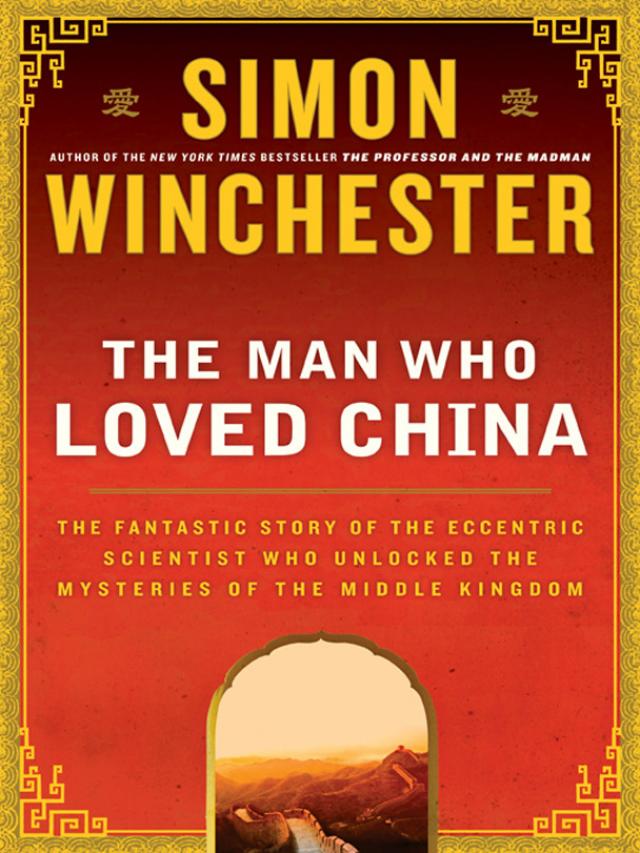
In sumptuous and illuminating detail, Simon Winchester, the bestselling author of The Professor and the Madman ("Elegant and scrupulous"—New York Times Book Review) and Krakatoa ("A mesmerizing page-turner"—Time) brings to life the extraordinary story of Joseph Needham, the brilliant Cambridge scientist who unlocked the most closely held secrets of China, long the world's most technologically advanced country.No cloistered don, this tall, married Englishman was a freethinking intellectual, who practiced nudism and was devoted to a quirky brand of folk dancing. In 1937, while working as a biochemist at Cambridge University, he instantly fell in love with a visiting Chinese student, with whom he began a lifelong affair.He soon became fascinated with China, and his mistress swiftly persuaded the ever-enthusiastic Needham to travel to her home country, where he embarked on a series of extraordinary expeditions to the farthest frontiers of this...
Read online
  • 67
Bomb, Book and Compass

Bomb, Book and Compass

Simon Winchester

Nonfiction / History / Travel

Before fate intervened, Joseph Needham was a distinguished biochemist at Cambridge University, married to a fellow scientist. In 1937 he was asked to supervise a young Chinese student named Lu Gwei-Djen, and in that moment began the two greatest love affairs of his life -- Miss Lu, and China.Miss Lu inspired Needham to travel to China where he initially spent three dangerous years as a wartime diplomat. He established himself as the pre-eminent China scholar of all time, firm in his belief that China would one day achieve world prominence. By the end of his life, Needham had become a truly global figure, travelling endlessly and honoured by all - though banned from America because of his politics. And in 1989, after a fifty-two year affair, he finally married the woman who had first inspired his passion.The Magnificent Barbarian is Simon Winchester at his best - at once a magnificent portrait of one man's remarkable life and a riveting exploration of the country that so...
Read online
  • 56
The Perfectionists

The Perfectionists

Simon Winchester

Nonfiction / History / Travel

The revered New York Times bestselling author traces the development of technology from the Industrial Age to the Digital Age to explore the single component crucial to advancement—precision—in a superb history that is both an homage and a warning for our future.The rise of manufacturing could not have happened without an attention to precision. At the dawn of the Industrial Revolution in eighteenth-century England, standards of measurement were established, giving way to the development of machine tools—machines that make machines. Eventually, the application of precision tools and methods resulted in the creation and mass production of items from guns and glass to mirrors, lenses, and cameras—and eventually gave way to further breakthroughs, including gene splicing, microchips, and the Hadron Collider.Simon Winchester takes us back to origins of the Industrial Age, to England where he introduces the scientific minds that helped usher in modern production: John Wilkinson, Henry Maudslay, Joseph Bramah, Jesse Ramsden, and Joseph Whitworth. It was Thomas Jefferson who later exported their discoveries to the fledgling United States, setting the nation on its course to become a manufacturing titan. Winchester moves forward through time, to today’s cutting-edge developments occurring around the world, from America to Western Europe to Asia.As he introduces the minds and methods that have changed the modern world, Winchester explores fundamental questions. Why is precision important? What are the different tools we use to measure it? Who has invented and perfected it? Has the pursuit of the ultra-precise in so many facets of human life blinded us to other things of equal value, such as an appreciation for the age-old traditions of craftsmanship, art, and high culture? Are we missing something that reflects the world as it is, rather than the world as we think we would wish it to be? And can the precise and the natural co-exist in society? **
Read online
  • 53
Exactly

Exactly

Simon Winchester

Nonfiction / History / Travel

Bestselling author Simon Winchester writes a magnificent history of the pioneering engineers who developed precision machinery to allow us to see as far as the moon and as close as the Higgs boson. Precision is the key to everything. It is an integral, unchallenged and essential component of our modern social, mercantile, scientific, mechanical and intellectual landscapes. The items we value in our daily lives – a camera, phone, computer, bicycle, car, a dishwasher perhaps – all sport components that fit together with precision and operate with near perfection. We also assume that the more precise a device the better it is. And yet whilst we live lives peppered and larded with precision, we are not, when we come to think about it, entirely sure what precision is, or what it means. How and when did it begin to build the modern world? Simon Winchester seeks to answer these questions through stories of precision's pioneers. Exactly takes us back to the origins of the Industrial Age,...
Read online
  • 44
Pacific

Pacific

Simon Winchester

Nonfiction / History / Travel

Travelling the circumference of the truly gigantic Pacific, Simon Winchester tells the story of the world's largest body of water, and – in matters economic, political and military – the ocean of the future. The Pacific is a world of tsunamis and Magellan, of the Bounty mutiny and the Boeing Company. It is the stuff of the towering Captain Cook and his wide-ranging network of exploring voyages, Robert Louis Stevenson and Admiral Halsey. It is the place of Paul Gauguin and the explosion of the largest-ever American atomic bomb, on Bikini atoll, in 1951. It has an astonishing recent past, an uncertain present and a hugely important future. The ocean and its peoples are the new lifeblood, fizz and thrill of America – which draws so many of its minds and so much of its manners from the sea – while the inexorable rise of the ancient center of the world, China, is a fixating fascination. The presence of rogue states – North Korea most notoriously today – suggest that the focus of the...
Read online
  • 29
Krakatoa

Krakatoa

Simon Winchester

Nonfiction / History / Travel

Simon Winchester's brilliant chronicle of the destruction of the Indonesian island of Krakatoa in 1883 charts the birth of our modern world. He tells the story of the unrecognized genius who beat Darwin to the discovery of evolution; of Samuel Morse, his code and how rubber allowed the world to talk; of Alfred Wegener, the crack-pot German explorer and father of geology. In breathtaking detail he describes how one island and its inhabitants were blasted out of existence and how colonial society was turned upside-down in a cataclysm whose echoes are still felt to this day.
Read online
  • 19
Outposts

Outposts

Simon Winchester

Nonfiction / History / Travel

Simon Winchester, struck by a sudden need to discover exactly what was left of the British Empire, set out across the globe to visit the far-flung islands that are all that remain of what once made Britain great. He traveled 100,000 miles back and forth, from Antarctica to the Caribbean, from the Mediterranean to the Far East, to capture a last glint of imperial glory.His adventures in these distant and forgotten ends of the earth make compelling, often funny reading and tell a story most of us had thought was over: a tale of the last outposts in Britain's imperial career and those who keep the flag flying.With a new introduction, this updated edition tells us what has happened to these extraordinary places while the author's been away.About the AuthorSimon Winchester was born and educated in England, has lived in Africa, Ireland, India and China, and now lives in US. He was a foreign correspondent for 30 years and now contributes to a variety of American and British magazines and newspapers. Hismost recent books have been the two international bestsellers, The Surgeon of Crowthorne and The Map that Changed the World. His new book, Krakatoa: The Day the World Exploded is published in June 2002. From AudioFileSimon Winchester travels to the far reaches of the British Empire. Winchester reads his own sometimes oddball tales. He tells of a cricket match on St. Helena in which a fielder falls off the edge and thus is "retired, dead." On Ascension Island, an island so small it was considered a ship--the H.M.S. ASCENSION--any baby born was considered born at sea. Winchester's nicely modulated voice is perfect for reading this history/travelogue. He is engaging while narrating the history and perpetually amused at the quirks of keeping the Empire alive no matter the discomfort. The production concludes with an interview in which Winchester discusses his delight at discovering that readers share his fascination with geology. A.B. © AudioFile 2005, Portland, Maine-- Copyright © AudioFile, Portland, Maine
Read online
  • 9
183